



How Much Does AI Software Development Cost in 2026
Founders involved in AI development can incur high costs when proceeding without a clear scope. It’s because the cost of AI app development depends on a combination of design decisions, infrastructure requirements, compliance requirements, and the quality of your data structure.
Revolut added an AI layer to block scam attempts by leveraging a clear workflow and well-scoped data. Such a build stays lean, and costs remain in control.
CoDoC tells a different story. DeepMind built it for clinical decision support, reducing false positives in breast cancer screening by 25%. Healthcare requires stringent testing and a long validation cycle, along with adherence to GDPR and DPA, resulting in high costs.
The answer to how much AI costs lies in identifying how complex a problem you’re trying to solve by implementing AI.
Let’s dive deeper into it.
Break Down the Core Cost Drivers of AI Software Development
To know exactly how much an Artificial Intelligence costs if adopted by your organization, it’s crucial to understand what moves the needle of your AI development cost.
While many factors affect the cost of AI software development, we’ll highlight four key forces.
I. Data Readiness and MLOps Maturity
The state of the data defines how quickly work progresses. What you want is clean and accessible data that keeps costs visible. Poor preparation can strain the team, leading to extended timelines and increased reliance on specialist labour to resolve issues.
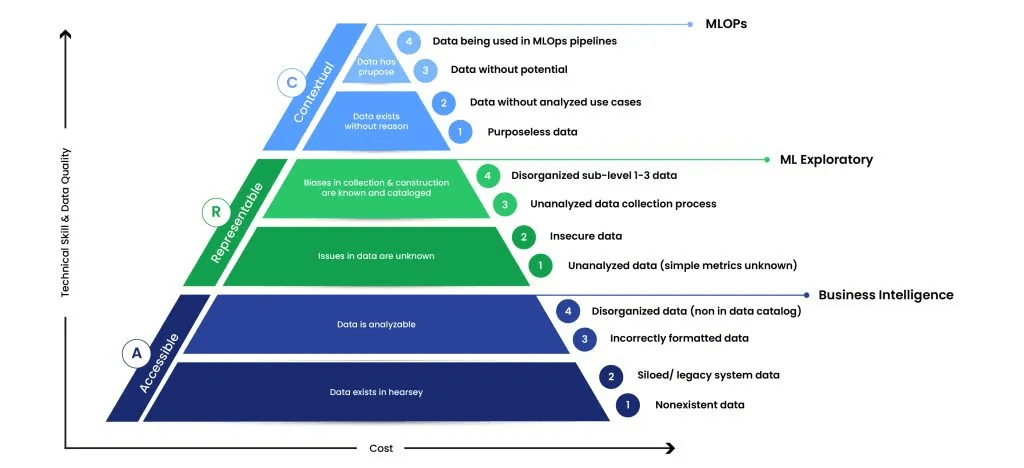
Here’s what goes in:
Data acquisition, cleaning, and labeling
AI models require teams to invest time in collecting data and removing clutter to produce labels that hold up under scrutiny. There’s an upfront cost to this because poor inputs lead to unstable outputs.
Ground truth and domain sign-off
Training any supervised AI model requires verified examples that define what the system should recognise. In regulated settings such as healthcare or finance, basic labelling is insufficient. Clinicians or compliance officers must formally validate labels so they reflect safe, defensible decisions in real-world use. That’s why medical data labelling often costs 3 to 5 times more than general image labeling because it requires annotators with clinical backgrounds.
Privacy by Design, DPIAs and Governance Boards
Regulatory compliance requires upfront spend, yet it protects projects from failure and costly penalties later. That reality carries particular weight under the UK GDPR and subsequent legislation, such as the Data (Use and Access) Act 2025.
Key considerations here:
- Privacy by Design (PbD): Requires integrating privacy controls into the data pipeline from the very first design sketch.
- DPIA and Governance: Before any sensitive data is processed, teams must complete a Data Protection Impact Assessment, which is then reviewed by internal data governance boards.
II. Model strategy choices
The model strategy drives AI development costs in very different directions. Some teams retain hosted APIs because they prioritize speed. Others fine-tune because they need context. Ultimately, the choice defines not just your technology stack, but your entire AI development cost structure.
Starling Bank offers a clear example of implementing real-time fraud detection models fine-tuned for specific use cases. The bank reduced fraud incidents by about 30% after the 2024 rollout and reported a 20-25% reduction in operational costs, citing the model’s ability to match precise fraud patterns.
The choices of the model will depend on:
This is the fastest, lowest-friction route. You call an external API that provides the intelligence. API-led builds reduce upfront AI software development cost by shifting complexity to the provider.
Teams use models from platforms such as OpenAI or Anthropic without training or hosting them, removing the need for specialised infrastructure.
API pricing is usage-based—you pay per token, but it needs the following considerations:
- The Scaling Trap
While the cost per token is low, it applies to both the input (your prompt/context) and the output (the answer). For complex tasks that require a long conversation history or large-context documents, token consumption increases.
- Model Tiering
Vendors segment models by performance and price. For example, Anthropic’s premium Opus models cost significantly more per token than their Haiku models, which requires balancing performance needs with budget.
Fine-tuning the Data
Fine-tuning provides a balance between customisation and cost control. Teams begin with a pre-trained model and adapt its final layers using a smaller, high-quality dataset drawn from a specific domain.
For example, ASOS uses fine-tuned AI models trained on curated outfit data to recommend clothing combinations by narrowing the model’s focus to its own catalogue and customer behaviour.
Building Fully Custom Models
A custom model is necessary when public models fail to meet specific performance or data security requirements. The same applies in regulated or performance-critical environments, where teams require direct control over latency, auditability, and how data moves through the system.
These two factors determine AI development cost:
- Choosing a Custom Build = High upfront cost (CapEx)
Machine Learning engineers and data scientists command premium talent rates because they drive high-end compute costs. After deployment, inference cost (the cost of running the model) is fixed and often lower, providing predictable OpEx. - Opting for API-Led = Low upfront cost
You avoid CapEx entirely; however, the long-term inference and licensing fees are variable (OpEx). As your user base grows and your application scales, token costs add up quickly. It may even lead to unpredictable and potentially substantial monthly expenses.
C. Infrastructure and Performance Influence the Energy Pricing
Advanced AI software requires powerful, specialised compute. The cost of AI software development increases with the number of GPUs and TPUs in use, as well as the hardware infrastructure required to host them.
The Stanford AI Index Report shows that training compute now doubles roughly every five months. That pace shifts the economics. GPU and TPU usage grow rapidly, followed by power consumption—thereby raising overall costs as systems scale.
The impact becomes clear when you look at the training costs behind some of the best-known AI models.
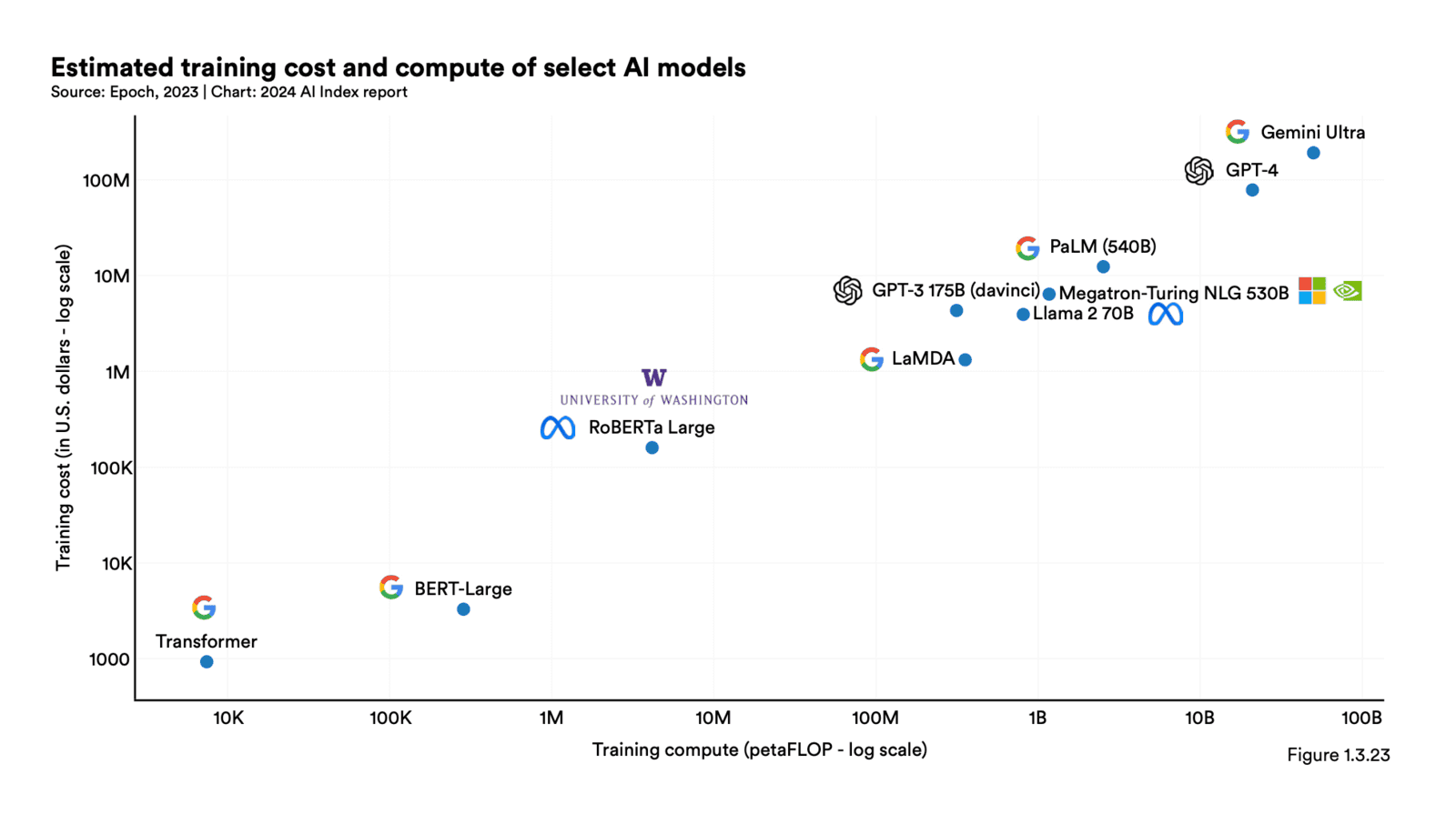
Such a scale creates a constant demand for capital and erects a real barrier for anyone outside the largest technology firm.
What can affect this part of the cost:
Specialized instances
Specialized instances are powerful cloud servers that feature custom hardware, such as high-end GPUs or TPUs, to perform rapid, parallel computations. A premium hourly rate for this cutting-edge silicon and a guaranteed speed translate into high fixed operating costs.
Scaling requirements
Beyond initial expenses, infrastructure costs may be elastic or fixed. The cost comparison requires a couple of key perspectives:
- Break-Even Analysis
A research paper examining the economics of deploying LLMs on-premises (similar to the cost structure of a custom fine-tuned model) shows that for organizations with high-volume processing requirements (e.g., 50 million+ tokens per month), the break-even period can be short. - Long-Term Savings
The ESG modelled the Total Cost of Inferencing LLMs found that internal solutions could be up to 4.1x more cost-effective than using a commercial API like GPT-4o for Retrieval-Augmented Generation (RAG) workloads.
Performance targets
Monitor performance targets when adopting AI and plan costs by assessing latency and throughput, as these factors affect infrastructure sizing.
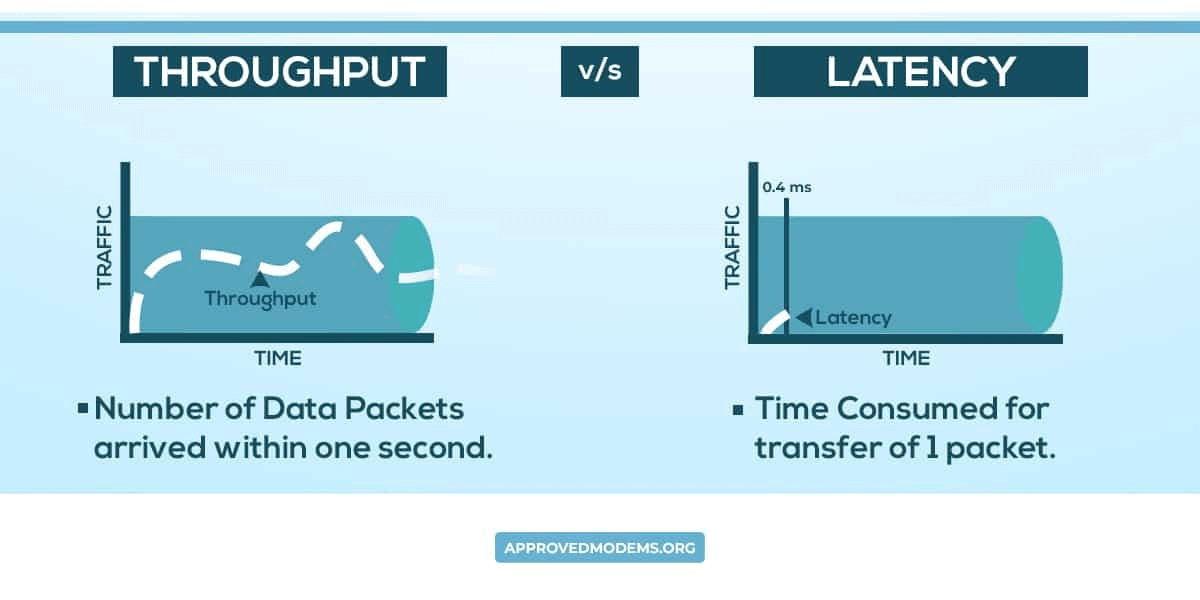
- Latency
See how much time your AI takes to respond. If building a real-time fraud detector or a live conversational AI, your latency must be extremely low (milliseconds matter). Achieving such a low level of latency requires picking the most powerful, and therefore expensive, specialised instances plus hardware configurations. - Throughput (Scaling Requirements)
Throughput determines the volume of requests an AI system processes per second. If the plan is to host millions of users, AI development costs can increase due to the massive scaling requirements. Much of it goes toward buying or renting more GPUs that require complex, low-latency networking fabrics to connect them.
Talent, Teams, and Vendor Day Rates
Another cost factor in AI development: human talent. People costs account for the bulk of AI spend in the UK because skilled practitioners are scarce.
Recent workforce studies show 73% of UK firms struggle to fill AI roles. Even government data reinforce the point, showing that around 65% hard-to-fill vacancies stem from skills shortages, with AI among the hardest areas.
Eventually, you’re forced to pay a premium because the talent pool is exceptionally low, with scarcity driving the pricing.
Typical UK Day Rates or Salary Bands for Key Roles
AI projects rely on specialists with deep technical expertise, who often consume a notable portion of your budget.
Here’s a typical cost:
| Role Title | Average Mid-Level Salary Band (UK) | Contract Day Rate (Typical) |
| AI/ML Engineer | £80,000 – £95,000 | £500 – £800 per day |
| MLOps Engineer | £85,000 – £100,000 | £550 – £850 per day |
| Data Scientist | £65,000 – £85,000 | £450 – £700 per day |
- Senior machine learning engineers and applied scientists command six-figure salaries or strong day rates when they have shipped production systems.
- MLOps and platform engineers follow closely because they keep models reliable once deployed.
- Domain specialists with AI exposure, such as clinicians or risk analysts, raise costs further since their availability remains limited.
Internal Team Versus External Specialist Partner Mixes
The strategic choice is how to balance the need for control (internal) against the need for speed and expertise (external). A hybrid model (more on it later) is often the most balanced approach of long-term control and immediate execution.
| Strategy | Pros | Cons | Best For |
| Internal Team | Full control over IP Deep business context Secure data handling |
High fixed costs Slow recruitment Constant training burden |
Core product features and long-term maintenance |
| External Specialist Partner | Immediate access to niche skills Flexible scaling Pre-built pipelines |
Higher day rates require vendor management
Knowledge flight risk |
Pilot projects and rapid prototyping involving complex technical hurdles |
Mixed models succeed when internal staff lead direction and partners deliver defined outcomes.
Why Hiring an AI Development Agency is Strategic
Many UK firms turn to an AI software development agency because it offers a strong option for businesses that need to move fast without the risk of a hiring process.
Agencies eliminate the hiring lag by bringing teams in with defined roles and shared working practices. There’s a lesser risk because engineers have already navigated similar failures elsewhere.
You get:
- Faster time-to-market as AI development agencies unlock access to their pre-vetted teams and established MLOps pipelines.
- Cost predictability by converting an unpredictable hiring budget into a fixed project fee, with agencies providing the necessary GPU hardware and cloud infrastructure.
- Access to senior knowledge that has built similar systems before to help prevent expensive architectural mistakes that often torment first-time internal teams.
Cost Breakdown | Development Budget Ranges by AI Use Case
If your AI implementation strategy is clear and you’re already planning next steps, the table below can provide a ballpark of AI development costs. These figures are indicative since the actual cost varies based on the factors discussed earlier.
| AI Implementation | Ballpark Cost Range (GBP) | Key Cost Drivers |
| Chatbots & Agents | £15,000 – £120,000 | Basic NLP / rule-based: £15k–£40k; Advanced with ML/sentiment: £50k–£120k (≈ 200–800 developer hours). |
| Recommendation Engines | £40,000 – £200,000 | Collaborative filtering basics: £40k–£80k; Personalised with real-time data: £100k–£200k (dataset labelling: £5k–£20k). |
| Predictive Analytics | £50,000 – £150,000 | Statistical models: £50k–£80k; ML forecasting with integrations: £90k–£150k (energy/compute adds 15–25% OpEx). |
| Vision Models | £100,000 – £500,000 | Image recognition MVP: £100k–£200k; Advanced (e.g., real-time detection): £250k–£500k (GPU training: £20k–£50k). |
| Voice Models | £120,000 – £400,000 | Speech-to-text basics: £120k–£200k; Multimodal with accents/compliance: £250k–£400k (slightly higher GPU usage than vision). |
| AI Search / RAG Systems | £40,000 – £200,000 | Basic retrieval: £40k–£80k; Enterprise RAG with vectors/LLM: £100k–£200k (storage/embeddings setup: £10k–£30k). |
Build vs Buy vs Hybrid AI Development in 2026: Budget, Timeline, and Control
An essential decision to build your AI in-house or buy a pre-existing solution is the most fundamental choice you will make. This choice sets your budget structure (CapEx vs. OpEx), determines your speed-to-market, and defines your long-term control.
What is “Buy” (API-Led)?
You use existing, ready-to-go services, typically via APIs (e.g., OpenAI, Anthropic, Google Gemini). The model is hosted, trained, and maintained by a third-party vendor.
| Factor | Description & Cost Influence |
| Cost Structure | Operational Expenditure (OpEx). Low upfront cost, but you pay a fee per token, per call, or per seat. |
| Time-to-Market | Fastest. Deployment is near-instant, with a working prototype in days to weeks. |
| Control & Customisation | Low.
Limited flexibility because you’re locked into the vendor’s roadmap, features, and model performance. |
| Core Advantage | Speed. Ideal for prototyping, testing assumptions, or for non-core functions like basic summarisation. |
| Cost Implication | Variable Costs. Your monthly bill is unpredictable, and as the usage scales up, costs increase linearly |
When Buying Makes Better Financial Sense
Buying works best when speed and cost control matter more than full ownership. API-first tools and existing AI platforms often deliver faster returns because the heavy lifting has already been done. It’s a suitable model for teams needing proven capability without funding long build cycles.
NatWest Group’s collaboration with OpenAI to speed up their Generative AI capabilities, rather than spending years building a Large Language Model from scratch. They focused on applying AI to specific customers and did not manage the underlying technology to keep deployment costs predictable.
When Building Becomes the Only Viable Option
Building your own AI system becomes unavoidable when control matters more than speed. This requires substantial Capital Expenditure (CapEx) in hardware and talent, as the system’s legal and performance requirements cannot be met with off-the-shelf APIs.
For example, Resolutiion built an AI-native platform to manage commercial disputes and conflict resolution. They rely on sensitive case data and structured legal reasoning, which off-the-shelf models would have limited control over.
This custom build delivered a platform that reduced administrative workload by over 50% and shortened dispute resolution time.
Hybrid Path
The Hybrid Path is the most common approach for large enterprises, as it strategically combines the speed and power of commercial AI APIs. Plus, it offers control and customisation of an internal build. This means using LLM APIs for general capability, adding fine-tuning where domain context matters, running custom inference for sensitive workloads, and tying everything together through workflow orchestration.
It is the strategy that balances speed, cost, and customisation.
For example, Tmotions leverages Azure OpenAI enhanced with additional Azure Cognitive Services. They built solutions based on the capabilities of the Azure OpenAI Service, gaining instant access to powerful models like GPT-4 without training them.
The project involves improving the base model by leveraging additional Azure Cognitive Services (e.g., sentiment analysis or multilingual speech recognition) and integrating it with custom datasets for specific industry use cases.
This approach balances speed, cost, and customisation.
Build vs Buy vs Hybrid: AI Development Comparison Table (2025–26)
This comparison table provides a high-level view of the three primary strategies for acquiring or developing AI capabilities in the enterprise. The differences reflect how AI systems behave when they move from pilots to day-to-day operations.
| Criteria | Buy (API-First) | Build (Custom AI) | Hybrid (APIs + Fine-Tuning + Custom Workflows) |
| Upfront Cost | £10k–£80k (lowest) | £150k–£500k+ (highest) | £40k–£250k (moderate) |
| Ongoing Cost | High (inference + API usage) | Low–Moderate (own infra) | Moderate (mixed infra + API use) |
| Time to Launch | Fastest (2–8 weeks) | Slowest (4–12 months) | Medium (8–20 weeks) |
| Accuracy / Performance | Good but generic | Best, domain-specific | High (improved via fine-tuning) |
| Data Residency Control | Limited | Full control | Partial to full (depends on setup) |
| IP Ownership | None | Full IP | Partial IP |
| Compliance Readiness | Medium (vendor dependent) | Highest (can be designed for GDPR, HIPAA, FCA) | High |
| Scalability | High but expensive | High but complex | Optimised for cost/scale balance |
| Security & Governance | Vendor managed | Organisation-managed | Shared responsibilities |
| Team Requirements | Small internal team | Full ML, data, and infra team | Small + vendor partnership |
| Best For | Startups, automation, support tools, chatbots | Healthcare, fintech, defence, proprietary workflows | Most mid-to-large companies |
| Downside | Vendor lock-in, cost grows with usage | Highest upfront cost, slow time to value | Requires orchestration planning |
| Example | NatWest Group x OpenAI | Resolution AI-native platform | Tmotions on Azure OpenAI |
Conclusion
The final cost of AI development is a direct consequence of a strategic balancing act between time, technical risk, and long-term control.
The high day rates driven by the UK’s talent shortage, combined with the escalating computational demands of models, make Build (Custom) solutions prohibitively expensive for non-core functions.
Once you move past the early assumptions, the real friction sets in — especially during data validation or when integrating with systems that were never built for AI workloads.
That’s why the majority of successful approaches for UK businesses in 2026 are hybrid models that provide immediate ROI and greater control over long-term operational costs.
Ready to see what AI experts can do? Talk to our AI experts today.