

23 AI Chatbot Use Cases for Business: Real Examples and What It Takes to Build
Most founders no longer ask whether to build a chatbot. They ask which one to build first.
That’s the harder question, and this guide answers it: not a shapeless list, but 23 AI chatbot use cases with real deployments behind them and a clear read on what each takes to build.
The timing isn’t an accident. Back in January 2025, OpenAI’s Sam Altman said that businesses might soon see the first AI agents “join the workforce” and materially change company output. Some of that has landed. Plenty of it hasn’t. The gap between the two is exactly where founders need to be careful.
So we’ve kept this practical. Every chatbot use case below is something a real business runs today, or a frontier worth watching. By the end, you’ll know which one to build first.
23 Chatbot Examples, and the Problems They Solve
These 10 are the flagship chatbot use cases with proven, named deployments behind them — a quick way to see the shape of what’s here. All 23, including the buildable ones without a household name, are covered in full below.
| Use case | What it does | Real example | Maturity | Best for |
|---|---|---|---|---|
| Tier-1 support | Handles routine queries | Klarna | Proven | High-volume support |
| Agent assist | Helps human agents reply | (QJE study) | Proven | Low-risk first build |
| Product discovery | Recommends by conversation | H&M | Proven | E-commerce |
| AR virtual try-on | Try products via camera | Sephora | Proven | Visual retail |
| Agentic checkout | Buy inside the chat | OpenAI, Perplexity | Frontier | Watch, don’t bet |
| HR helpdesk | Answers staff questions | IBM AskHR | Proven | Internal ops |
| Banking assistant | Balances, alerts, actions | Bank of America | Proven | Financial services |
| Healthcare triage | Assesses symptoms | Ada Health, NHS 111 | Emerging | Regulated care |
| Tutoring | Guides learners 1-to-1 | Khanmigo | Proven | Education |
| Voice agents | Spoken conversation | HSBC Voice ID | Frontier | Hands-free needs |
23 AI Chatbot Use Cases for Business: Real Examples and What It Takes to Build Each
1) Customer service and support
This is where most businesses start, and for good reason: the work is high-volume, repetitive, and well understood. Get it right here, and the returns show up fast.
1. Tier-1 support automation
The classic first move: let a bot handle the flood of routine questions so your team can focus on the hard ones. Klarna’s numbers made this famous. Within a month of launch, its OpenAI-powered assistant handled 2.3 million chats, two-thirds of its total, doing work Klarna equated to roughly 700 full-time agents. Resolution times dropped from 11 minutes to under two.
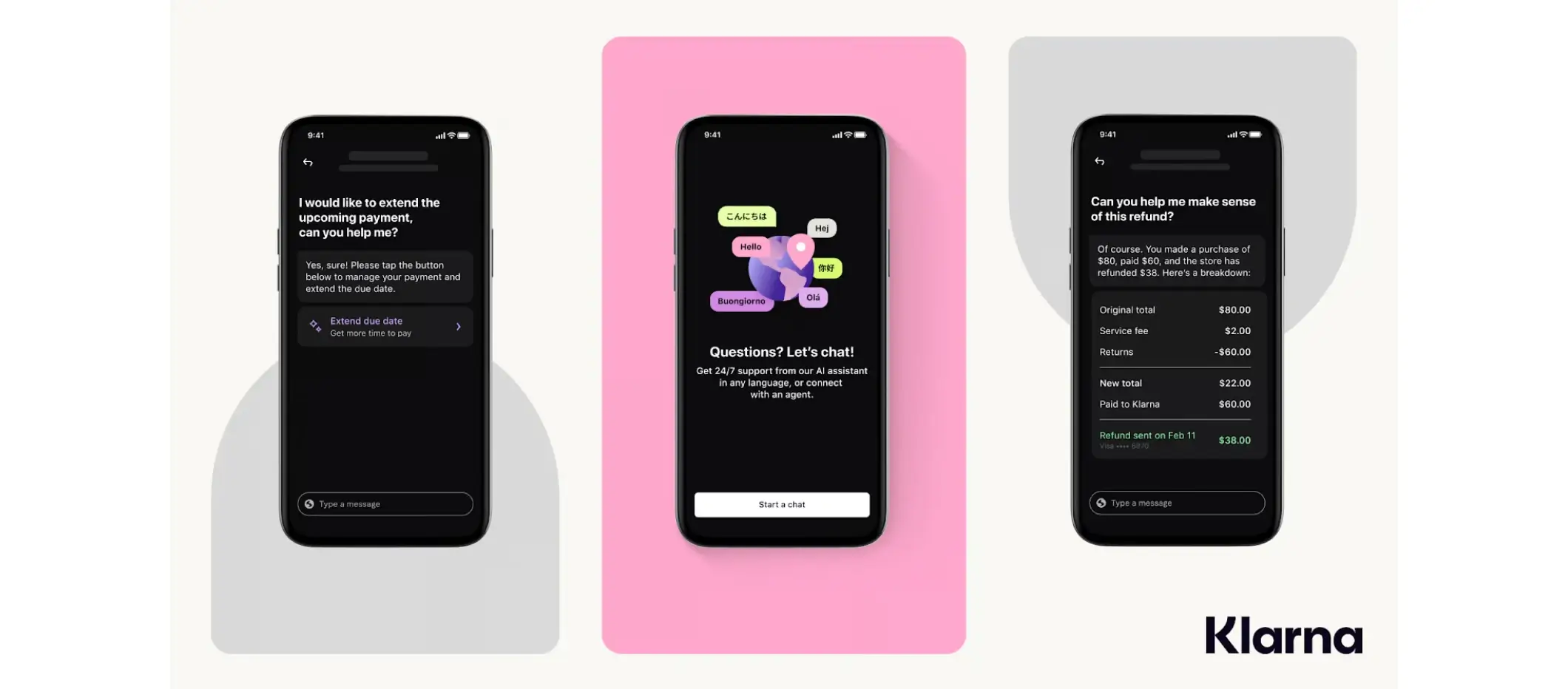
Then came the part fewer people quote. By 2025, Klarna rebuilt its human team, with its CEO admitting they’d leaned too hard on cost and let quality slip. The lesson isn’t “don’t automate.” It’s that the bot handles the volume tier and humans handle the value tier, and deciding where that line sits is a design choice, not a target to max out.
This is the kind of judgement we bring to custom AI development work: matching the tool to the job rather than automating for its own sake.
Build this if your support team drowns in the same few questions every day.
2. Agent assist / human co-pilot
If full automation feels risky, this is the safer place to start. Instead of replacing the agent, the bot sits beside them, drafts replies, surfaces the right answer, and lets a human make the final call. The stakes are lower, and the upside is well evidenced.
The largest study to date, published in the Quarterly Journal of Economics, tracked over 5,000 support agents and found AI assistance lifted the number of issues resolved per hour by 14% on average, and 34% for the newest, least experienced staff. In plain terms: it makes your weakest agents perform more like your best ones, without taking the human out of the loop.
Build this first if you want the gains of AI support without betting the customer relationship on it.
3. Ticket triage and routing
Not every bot needs to answer the question. Sometimes the win is just getting the question to the right place, fast. A triage bot reads an incoming request, works out what it’s about and how urgent it is, then routes it to the right queue or person before anyone has to read it manually.
It’s an unglamorous use case that quietly saves hours. Bank of America built this kind of routing into its internal tools and cut calls to its IT service desk by half. The build is simpler than a full answering bot too, because you’re classifying and directing, not resolving. For many teams that makes it a sensible early step.
4. Post-purchase — tracking, returns, refunds
“Where’s my order?” is the most predictable question in commerce, and a bot answers it instantly, day or night. Connect it to your order system, and it handles tracking, returns, and refunds without a human touching the ticket, and it can flag a delay before the customer even asks.
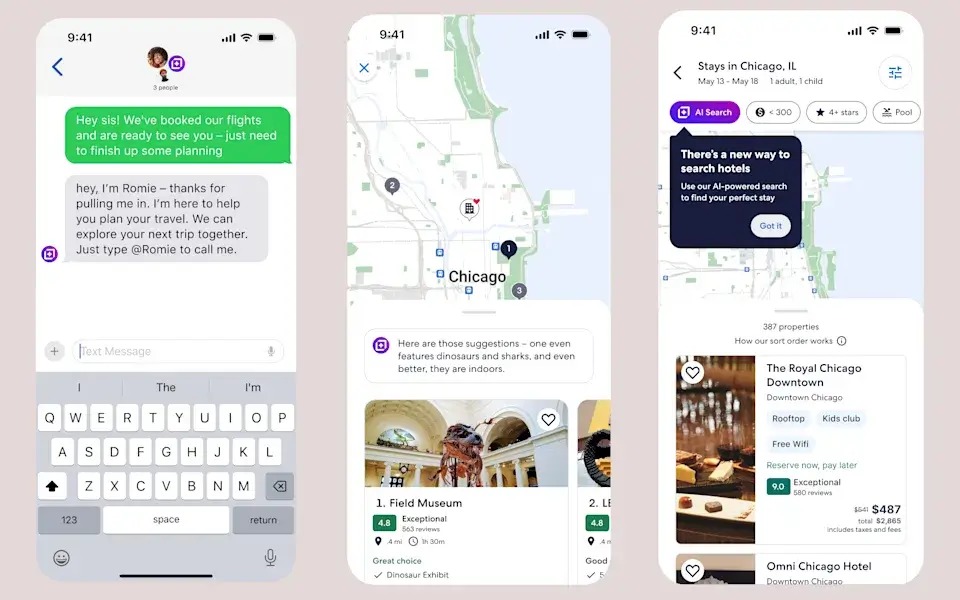
Expedia’s assistant lets travellers change hotel dates and cancel bookings in chat; brands like Gymshark run the same playbook for order tracking. Because these questions are high-frequency and low-complexity, they’re easy to automate, making this a strong early build for any e-commerce operation.
Start with your single most-asked post-purchase question and expand from there.
2) Sales, marketing and lead generation
Support saves you money. This is where a chatbot starts making you money: it catches interest the moment it shows up instead of letting it cool in an inbox.
5. Lead qualification and conversion
A contact form is a dead end with a “submit” button. A chatbot turns that same moment into a conversation: it asks the qualifying questions a sales rep would, works out whether the visitor is worth a call, and books the meeting on the spot while the interest is hot.
The trick is that the bot should replace the form, not sit next to it. A widget in the corner that duplicates a form you already have adds friction; a bot that owns the whole first conversation removes it.
For most B2B businesses, this is the highest-value early build, because a qualified lead routed to a rep in real time is worth far more than the same lead sitting overnight in a queue.
Build this if leads arrive faster than your team can respond.
6. Product discovery and recommendation
Filters and search bars ask the shopper to do the work. A recommendation bot does it for them: the customer describes what they’re after in plain words, and the bot returns a short, personalised shortlist they can buy from without clicking away.
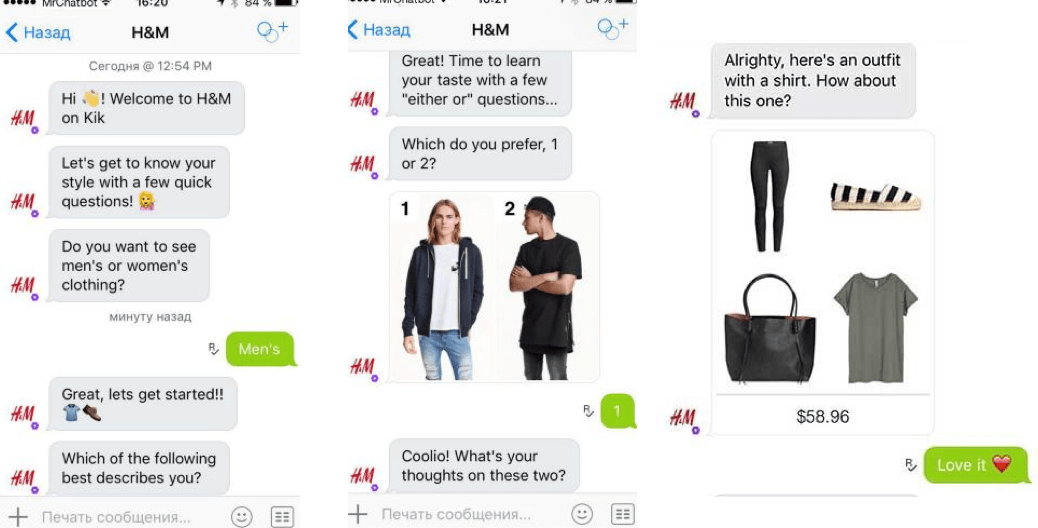
Think of it as a good shop assistant who remembers what you looked at last time.
H&M’s chatbot asks about style, budget and size, then builds outfits around the answers; shoppers spend around four minutes with it before clicking through. It works because it meets people who know roughly what they want but not exactly how to find it, which is most of them.
Ground it in your live catalogue, and it becomes a salesperson who never sleeps and never forgets your stock.
7. Abandoned-cart recovery
Roughly seven in ten online carts get abandoned, and most of that is recoverable.
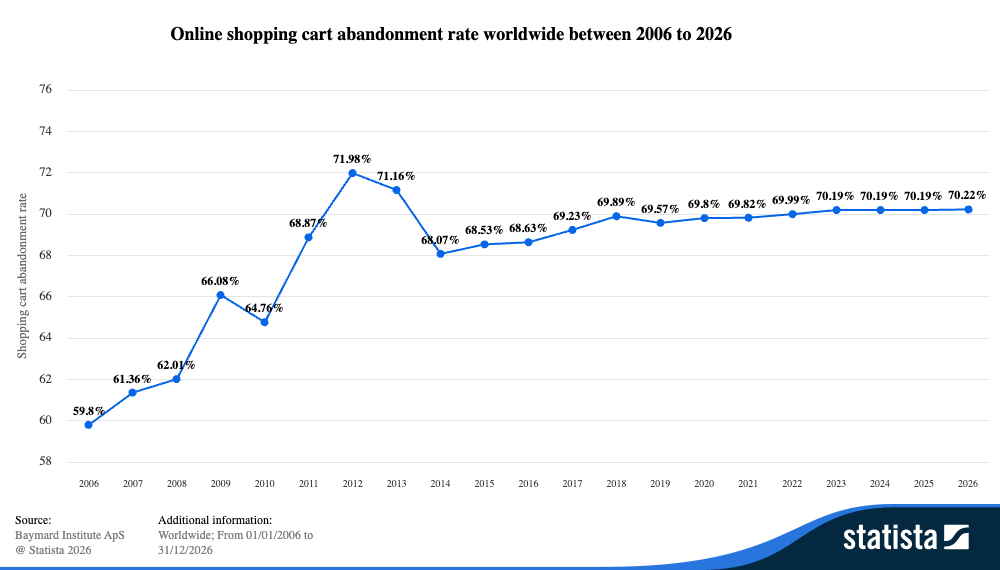
A chatbot steps in at the drop-off point, or shortly after, to answer the one objection that stalled the sale: a question about shipping, a wobble on sizing, a hesitation over returns. Not a discount blast to everyone, but a targeted nudge to the person who was almost there.
Kept tight and relevant, it quietly claws back revenue you’d otherwise have lost. Where discovery helps people find the thing, recovery helps people finish buying it, and together they cover the whole path from browsing to checkout.
Marc Benioff, whose company Salesforce sells these tools, put the mood of the moment plainly: “The agent revolution is real and it’s as exciting as anything I’ve seen in my career. It’s as exciting as the cloud revolution, or the internet revolution, or the mobile revolution. And it’s happening right now.” — Marc Benioff, Chair and CEO, Salesforce
Take the vendor enthusiasm with a pinch of salt. But the direction of travel is real, and it’s moving faster than ever in how people shop. Which brings us to the frontier.
3) E-commerce and conversational commerce
This is where chatbots stop assisting and start transacting. The early use cases here are proven; the last two are the genuine frontier, full of promise and still finding their feet.
8. AR virtual try-on
Some things you can’t decide on from a product photo. A try-on bot uses the phone camera to let the customer see the lipstick on their own lips or the sofa in their own room, then talks them through the options.
It’s a chatbot with eyes, and it works because it removes the biggest reason people hesitate online: not knowing how something will actually look.
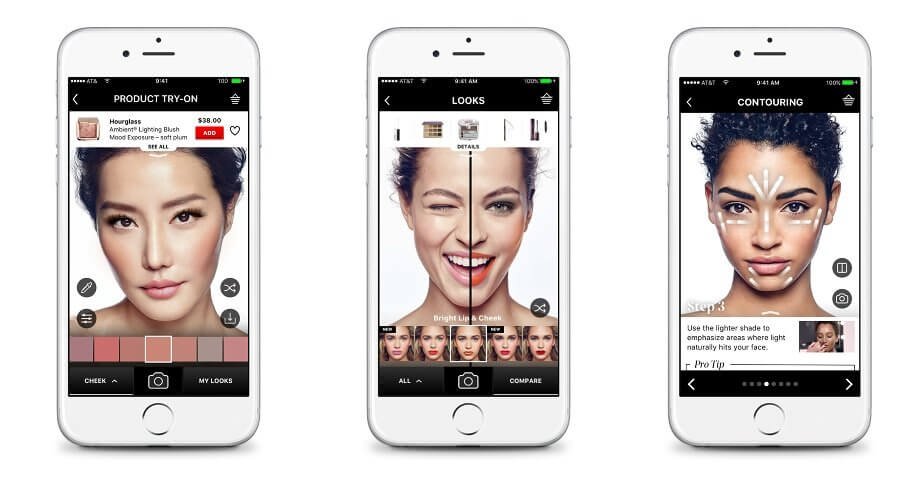
Sephora’s Virtual Artist lets shoppers try makeup virtually before buying, and it’s become the category’s reference example. The technology behind it, ModiFace, now powers L’Oréal’s try-ons too, and the appetite is clear: L’Oréal’s virtual try-on sessions grew by 150% in a single year, from 40 million in 2022 to over 100 million in 2023.
The lesson for a founder: this is worth building when what you sell is visual, and returns are driven by “it didn’t look how I expected.” For everyone else, it’s a lovely gimmick you don’t need.
9. Booking and appointment scheduling
This one is quietly everywhere. A booking bot checks live availability, reserves the slot, and sends the reminders that stop people forgetting, all inside the chat. No back-and-forth emails, no phone tag.
It suits any business that runs on appointments: salons, clinics, consultants, repair shops. Even Bank of America’s Erica lets customers book an appointment and hands them cleanly to a human advisor for the high-touch conversation. It sits in the commerce section here, but don’t be fooled: scheduling is one of the most transferable use cases in this whole list, and often the easiest to justify.
10. Conversational commerce agentic checkout
Here’s the big idea: the customer discovers, chooses, and pays for a product without ever leaving the conversation. The bot handles the cart and the payment. The entire shopping funnel collapses into a single chat.
It’s also the clearest example of why the frontier deserves caution. OpenAI launched Instant Checkout in ChatGPT in September 2025, letting people buy directly inside the chat.
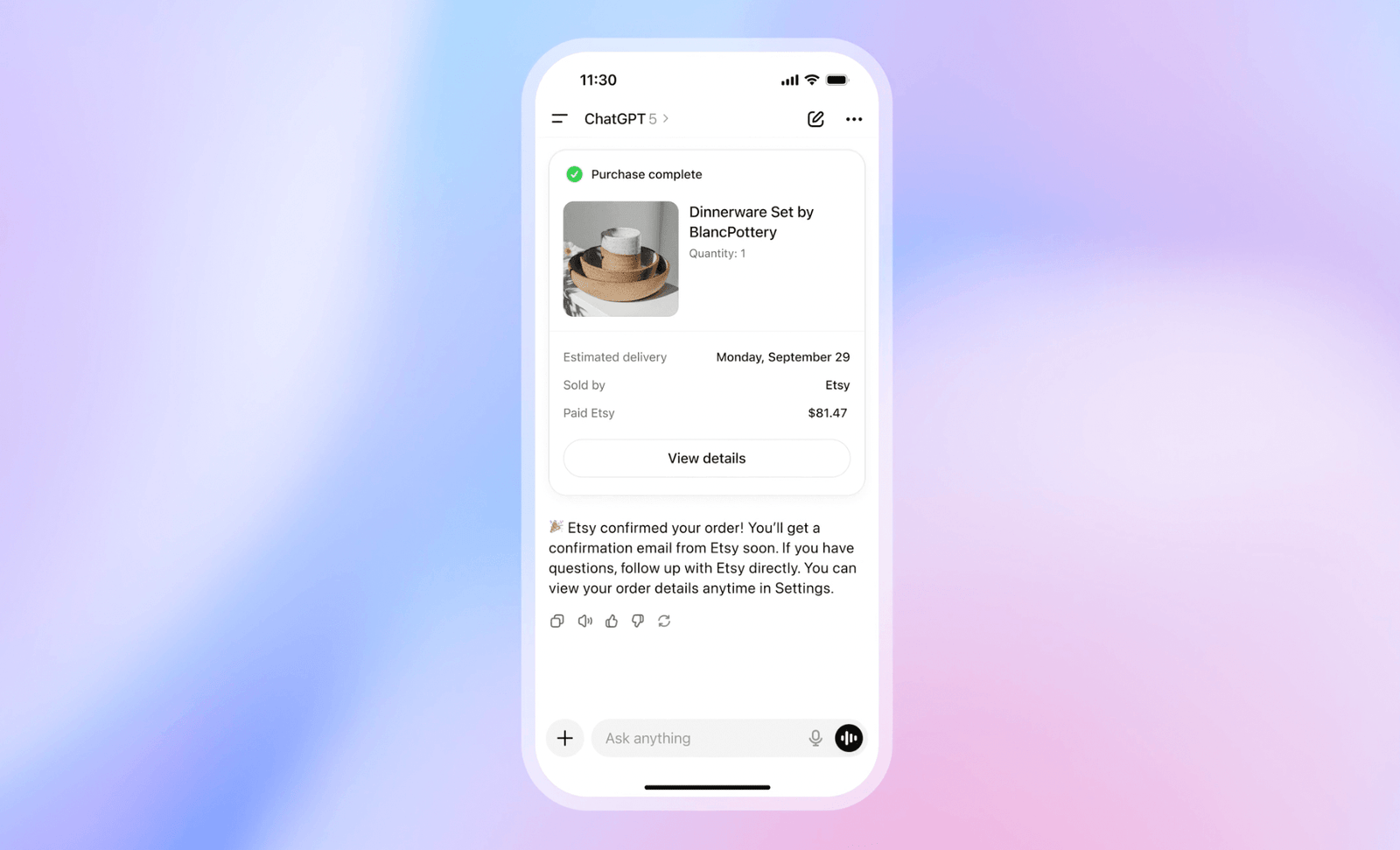
By March 2026, it had discontinued the feature, refocusing on product discovery after finding shoppers researched in ChatGPT but didn’t convert there, and after running into hard problems like sales-tax handling and real-time inventory.
Only 30 of Shopify’s millions of merchants ever went live. Meanwhile, Perplexity partnered with PayPal to let its users check out in-chat, and Amazon built buying straight into its Rufus assistant.
So the honest read: discovery through AI works, and works well. Fully autonomous in-chat checkout is still unproven at scale. If you’re building here, build for discovery first and treat checkout as the part that isn’t settled yet.
Nvidia’s Jensen Huang, whose chips power most of this, was blunt about the pace when asked about autonomous AI agents: “I think this year we’re going to see AI agents really take off. The IT department of every company is going to be the HR department of AI agents in the future.” — Jensen Huang, CEO, Nvidia, at CES 2025.
11. Agent-to-agent commerce
Now the furthest edge. If your customer has their own AI agent doing their shopping, then your bot’s real job is to sell to their bot. The buyer may not be human at all. Two agents negotiate, compare, and transact, machine to machine, and the businesses whose systems can speak that language get considered while the rest are invisible.
This is early. Protocols for it are still being written, and most businesses don’t need to act today. But the practical takeaway is simple and worth banking now: build your product data and systems to be clean, structured, and reachable by an API. That’s what makes you legible to an agent later, and it costs nothing extra to do it properly from the start.
Not sure which of these is worth your time and which is still a science experiment?
That’s exactly the kind of thing worth working out before you commit a budget. Bring us the problem you’re trying to solve, and we’ll tell you straight where a chatbot earns its place and where it doesn’t.
4) Internal operations and employee-facing
Everything so far has faced your customers. Some of the highest-return, lowest-risk chatbots never do. They point inward, at your own team, where a wrong answer costs you an awkward moment rather than a customer.
Shopify’s Tobi Lütke made the internal case bluntly in a memo to his staff: “Before asking for more headcount and resources, teams must demonstrate why they cannot get what they want done using AI. What would this area look like if autonomous AI agents were already part of the team? This question can lead to really fun discussions and projects.” — Tobi Lütke, CEO, Shopify
You don’t have to go as far as Lütke to see the point: a lot of internal work is just repeated questions, and repeated questions are exactly what a chatbot handles best.
12. HR helpdesk and self-service
Every HR team answers the same questions on a loop: how much leave do I have left, when’s payday, what’s the sickness policy. An HR bot answers all of it instantly, in the employee’s own language, and can actually process requests rather than just point at a policy document.
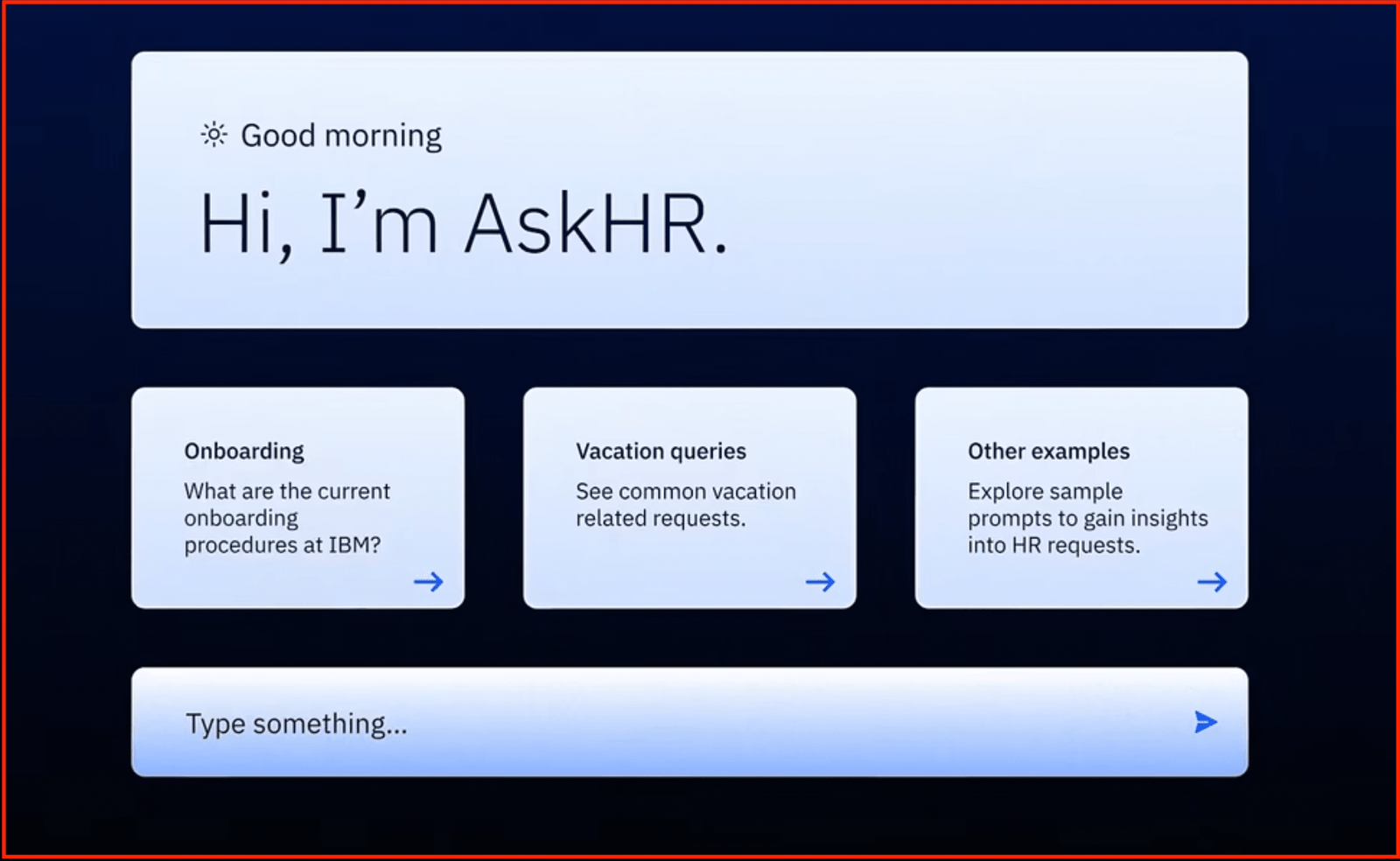
IBM’s AskHR bot stands out: it handles more than 2.1 million employee conversations a year, automates over 80 HR tasks, and resolves most queries without ever needing a human. It runs on a simple two-tier model: the bot takes the routine, people take the complex, which is the same sensible split we saw in customer support.
For a non-technical founder, this is often the easiest first build on the list: a clean return, and no customer sees it if it stumbles.
Build this if your HR or ops team spends its days answering the same handful of questions.
13. Employee onboarding
The first week at a job is a blizzard of paperwork, logins, and “who do I ask about this?” An onboarding bot walks each new hire through it: the checklist, the documents, the benefits questions, and the access requests, all in one place, at whatever pace they need.
Accenture built exactly this to guide employees through common HR tasks. It’s low-risk and high-goodwill, because it makes people’s first impression of your company feel organised rather than chaotic. And it reuses most of what an HR helpdesk bot already knows, so if you build number 12, this one is a short step further.
14. IT helpdesk and password reset
“I’m locked out.” It’s the most common IT ticket in the world, and it doesn’t need a human. An IT bot resets the password, restores access, and passes anything more serious to the right person, so the tech team stops firefighting the trivial stuff and gets its time back.
Bank of America put this to work internally and cut calls to its IT service desk by half. The appeal is simple: a small number of request types (password, access, basic troubleshooting) make up most of the volume, so even a modest bot that handles only those clears a real backlog.
15. Internal knowledge assistant (RAG over docs)
Your company already knows the answer to most internal questions; it’s just buried in documents nobody can find. A knowledge assistant lets staff ask in plain language and pulls the answer straight from your own files, so people stop firing single-question pings into Slack all day.
The technique behind it is called RAG, retrieval-augmented generation, which is a fancy way of saying the bot looks up the answer in your documents before it speaks, rather than guessing.
That grounding is what makes it trustworthy, and getting it right is its own discipline, which we cover in our guide to AI chatbot best practices.
Goldman Sachs and Walmart both run internal assistants of this kind for their staff. For a knowledge-heavy business, it’s one of the most quietly transformative builds available.
16. Developer Coding Copilot
If your business writes software, a coding copilot is a chatbot for your engineers: it drafts code, reviews it, and explains it, keeping developers in flow instead of hunting through documentation. It’s aimed inward at your own team rather than at customers, which is worth saying plainly so it isn’t confused with the customer-facing bots above.
The gains are real and measured. Bank of America rolled coding assistance out to 17,000 developers and saw productivity rise by around 20%.
If you’re an AI software company, this is less a customer play and more a way to get more out of the team you already have.
5) Industry-specific
The use cases so far cross every sector. These five are shaped by the industry they live in, where rules, stakes, and regulations change what “good” looks like. Where an industry carries real risk, I’ve said so plainly.
17. Banking — balances, transactions, and proactive alerts
Banking was one of the first industries to prove chatbots at serious scale. A banking bot lets customers check balances, review transactions, and get answers to money questions instantly, around the clock, without waiting in a call centre queue.
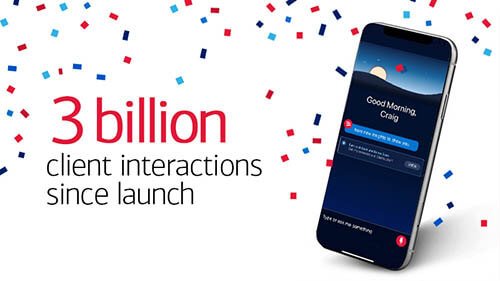
Bank of America’s Erica is the benchmark: since 2018, it has passed 3 billion client interactions across nearly 50 million users, and most find what they need without a human. The part worth copying isn’t the scale; it’s the shift from reactive to proactive.
Erica doesn’t just answer questions; it has delivered well over a billion proactive nudges, like flagging which way a balance is trending over the next seven days.
That’s the real lesson: the most valuable banking bot tells customers what they need to know before they think to ask. One caveat governs the whole sector, though: every action has to be authenticated and tightly bounded, because the cost of a mistake here is measured in money and trust.
18. Fraud-alert response and card actions
A close cousin of the banking bot, pointed at a sharper problem. When something looks wrong on an account, the bot lets the customer respond in the moment: confirm or deny a suspicious transaction, lock a card, review recent activity, and escalate straight to the fraud team if it’s serious.
Erica handles exactly these flows for Bank of America customers. What makes it work is discipline, not cleverness: the bot can take a small set of clearly defined, authenticated actions and nothing more. For any founder in financial services, that’s the model: narrow, bounded, and safe by design, rather than a chatty assistant with the keys to the account.
19. Healthcare triage and symptom checking
This is the highest-stakes use case in the entire list, and it deserves the most caution. A triage bot asks a patient about their symptoms, assesses urgency, and points them to the right level of care: self-care, a booking, or straight to emergency help.
Ada Health has more than 23 million users, and in a British Medical Journal evaluation, its symptom assessment performed respectably and improved further when paired with a doctor’s review.
In the UK, NHS 111 Online does triage at national scale. But the non-negotiable here is safety: a healthcare bot needs airtight escalation rules and genuine clinical oversight, because the failure mode isn’t an annoyed customer, it’s a missed emergency. Build here only if you can commit to that standard, and expect the regulation that comes with it.
20. Appointment reminders and post-discharge follow-up
Not all healthcare AI carries the same risk. Some of the most useful medical bots never touch a diagnosis. Instead, they handle the admin around care: reminding patients of appointments, checking in after a discharge, prompting people to take medication, and flagging worrying answers for a human to review.
The appeal for a healthcare provider is that these bots reduce no-shows and catch problems early without making clinical judgments, keeping them on the safer side of the line while still delivering real value. The same safety-first framing from triage applies, just with lower stakes.
21. Education — personalised tutoring
A tutoring bot gives every learner something scarce: a patient, one-to-one teacher available at any hour, adapting to their pace and level. The best of them don’t hand over answers; they guide the student to work it out.
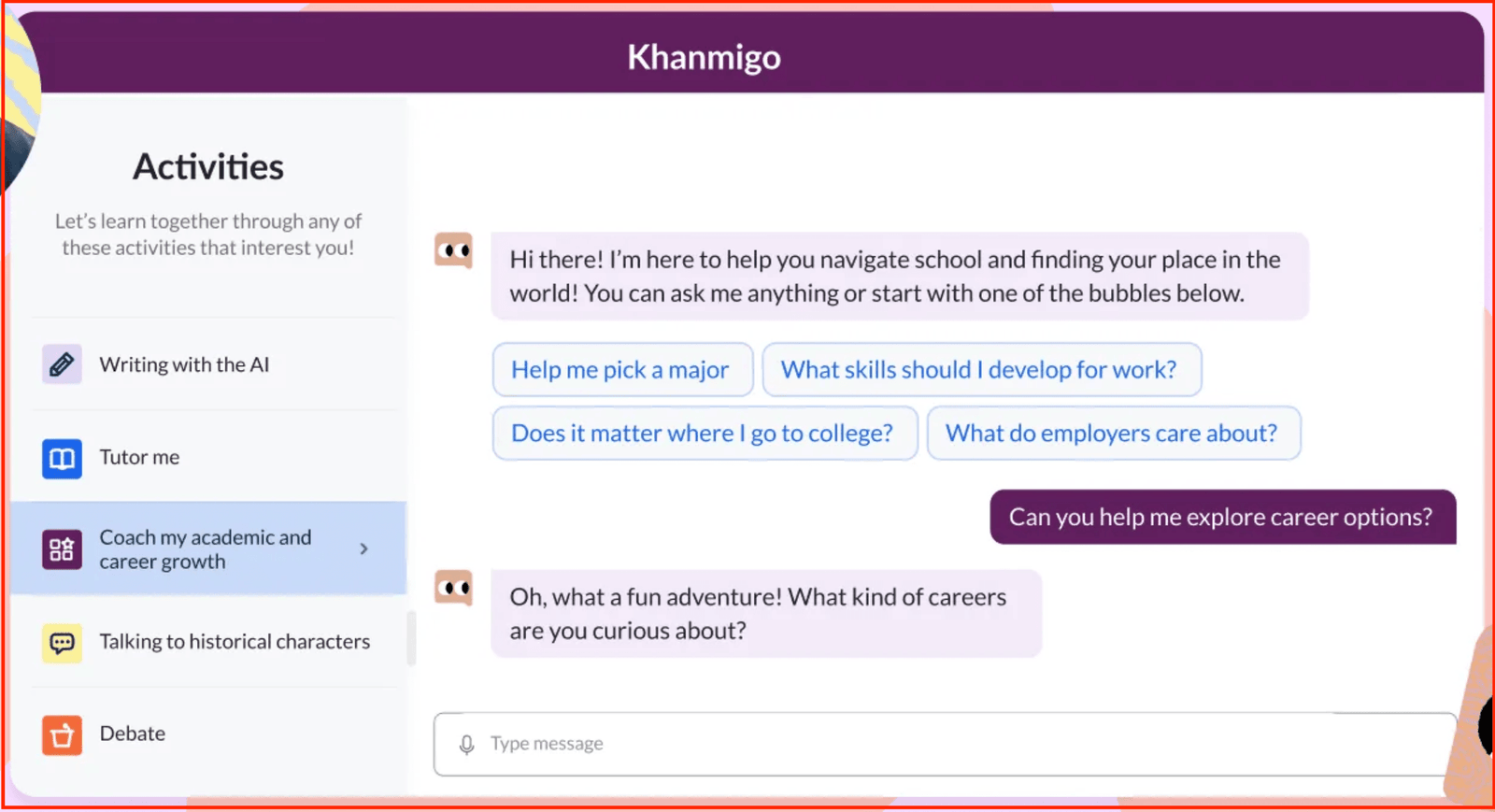
Khan Academy’s Khanmigo is the model here: it uses the Socratic method, asking guiding questions rather than giving the solution. Duolingo Max does the same for languages, with AI roleplay conversations.
The design choice worth noting for any builder in education is the guardrail: these bots are deliberately built to guide, not to do the homework, and that restraint is what makes schools trust them.
6) Channel and interface
The last two aren’t about what a chatbot does, but where it lives and how you talk to it. Sometimes the channel is the whole advantage.
22. WhatsApp and messaging-channel service
Most chatbots wait on your website for someone to visit. A messaging bot goes to where people already are: WhatsApp, Instagram, the apps they check dozens of times a day. The conversation happens in a thread they already trust, and it can carry both service and sales without asking anyone to install anything new.
Expedia’s Romie assistant works over WhatsApp and iMessage, helping travellers plan and adjust trips inside a normal chat. The strategic point for a founder is reach: in much of the world, and especially across emerging markets, WhatsApp isn’t a channel, it’s the internet.
If that’s where your customers live, meeting them there beats making them come to you. Pick the channel your audience actually uses, then build for it.
23. Voice AI agents
The final frontier in this list swaps typing for talking. A voice agent holds a spoken conversation, handles the request, and can even recognise who’s speaking by their voice alone. It’s the most natural interface, and the hardest to get right.
HSBC’s Voice ID authenticates customers using over a hundred voice characteristics, turning speech itself into a password. Voice sits at the frontier because of engineering: doing it well means near-instant responses and very high accuracy, because people forgive a slow chatbot but not a slow conversation. Build here when the hands-free, spoken experience is genuinely better for your customer, and go in knowing the technical bar is higher than anything else on this list.
How to Choose the Right AI Chatbot Use Case for Your Business
23 chatbot use cases is a menu, not a to-do list. The mistake is trying to build several at once. Pick one, get it working, then expand. Here’s the order I’d use to choose it.
- Start where the pain is most repetitive. Look at where your team answers the same question over and over, whether that’s “where’s my order,” a leave-balance query, or a password reset. High volume and low complexity is the sweet spot for a first build.
- Weigh the cost of a wrong answer. A bot fumbling a product recommendation is a shrug; one fumbling a medical or financial answer is a serious problem. Start where mistakes are cheap.
- Build assist before autonomy. Let the bot help a human before you let it act alone. It’s the lower-risk path to the same destination.
The honesty runs the other way too. Klarna automated hard, then rehired people, with its CEO telling Bloomberg: “As cost unfortunately seems to have been a too predominant evaluation factor when organising this, what you end up having is lower quality.” — Sebastian Siemiatkowski, CEO, Klarna
The point isn’t to automate everything. It’s to automate the right thing well. That’s the judgement we make with clients every week, and it’s usually the difference between a chatbot that pays for itself and one that quietly gets switched off.
If you want to see how we approach AI chatbot development end to end, start there.
When you’re ready for a straight read on which use case fits your business, book a discovery call.
We’ll map your first build with you. Not sure a chatbot’s even the right tool? We’ll tell you that too.