

The Best AI Chatbot Development Companies in the UK in 2026 Compared
Explore the top AI chatbot development companies in the UK, including QuantumXL. Compare their services and expertise to find the right partner for your build.

On this page
- Top AI Chatbot Development Companies in the UK: Quick Comparison
- 8 Top AI Chatbot Development Companies in the UK
- 1. QuantumXL – Best For Custom, Production-Ready Builds
- 2. Magora Systems – Best for Enterprise Custom Software
- 3. Waracle – Best for Regulated Sector Enterprises
- 4. Softomate Solutions – Best for SMEs Wanting Fixed Price
- 5. Konversable – Best for WhatsApp & Vertical Use Cases
- 6. Ronins – Best for Design-Led Chatbot Projects
- 7. Incepteo – Best for Mid Market AI Adoption
- 8. Pixelette Technologies – Best for Budget Conscious Builds
- Ready to Build Your AI Chatbot?
Over the years, I’ve worked alongside teams that build AI chatbots for UK businesses. I’ve seen agencies that ship reliable systems and those that overpromise and under-deliver. That firsthand view shaped this shortlist of the best AI chatbot development companies in the UK.
I’ve compared 8 AI chatbot development companies here, including QuantumXL, Magora Systems, and Waracle. Each earns its place for a different reason: some for enterprise-scale delivery, others for conversational design or custom LLM engineering.
Below, you’ll see how these UK-based AI chatbot agencies compare on specialism, ideal use case, and verified client ratings. All reviewed and updated on 24 August 2026 to reflect where each team stands today.
Top AI Chatbot Development Companies in the UK: Quick Comparison
Here’s how the leading AI chatbot development companies in the UK compare at a glance — matched to the kind of business and build each one suits best.
# | Company | Best for | Specialism |
|---|---|---|---|
1 | QuantumXL | Custom, production-ready builds | Bespoke AI chatbots trained on your data |
2 | Magora Systems | Enterprise custom software | AI chatbots within larger builds |
3 | Waracle | Regulated-sector enterprises | Mobile + AI at scale |
4 | Softomate Solutions | SMEs wanting fixed-price | Multi-channel + WhatsApp bots |
5 | Konversable | WhatsApp & vertical use cases | WhatsApp Business chatbots |
6 | Ronins | Design-led chatbot projects | Conversational UX + build |
7 | Incepteo | Mid-market AI adoption | AI + software development |
8 | Pixelette Technologies | Budget-conscious builds | Web, app + AI development |
8 Top AI Chatbot Development Companies in the UK
Here’s how the top AI chatbot development companies in the UK compare, each picked for a different strength. Every entry covers what they do, who they’re best for, and where they fit — so you can match the right team to your project.
1. QuantumXL – Best For Custom, Production-Ready Builds
We’re a UK AI development team that builds bespoke AI chatbots for businesses that need more than an off-the-shelf widget.
We work with founders, support teams, and enterprises to design chatbots trained on your data, workflows, and business language—handling real customer conversations, qualifying leads, and automating support across web, mobile, and internal systems.
Our approach is built around production-readiness. Rather than configuring a template, we engineer each bot from the ground up, test it against real queries and edge cases, and integrate it with your CRM and existing tools before launch — then tune it post-deployment so it stays reliable as you scale.
If you want an AI chatbot built around how your business actually runs, that’s exactly the work we do.
Best for: Businesses wanting a custom, production-ready chatbot built and integrated end-to-end.
Key strengths:
- Bespoke chatbots trained on your data, not templates
- Deep integration with your CRM and existing systems
- Tested for production, so it works with real users
- Ongoing tuning and support that keeps it reliable
Are you planning to build a custom AI chatbot for your business?
Book a discovery call with us, and we’ll help you scope the build.
2. Magora Systems – Best for Enterprise Custom Software
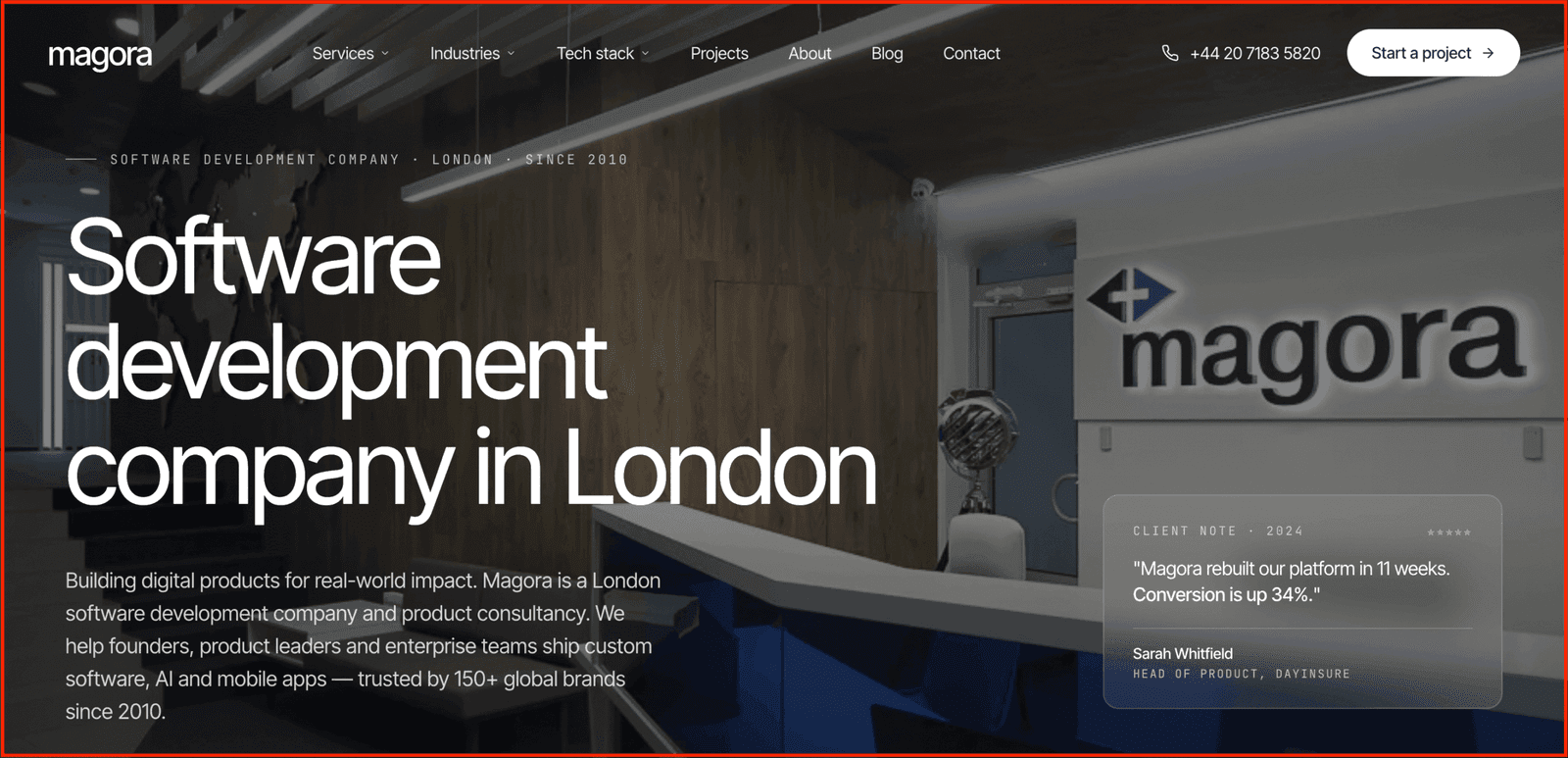
Magora is a London-based company that builds custom software, mobile apps, and AI.
Chatbots aren’t their whole story — they sit inside a broader offering that spans web and mobile builds, predictive analytics, and enterprise integrations across sectors like healthcare, logistics, and finance.
That makes Magora a sensible pick if a chatbot is one part of a bigger software project rather than the main event.
If you’re already commissioning a web platform or mobile app and want conversational AI baked in, they’ve got the full-stack team to handle it under one roof — with a discovery-led process and post-delivery support that suits founders and enterprise teams alike.
Best for: Businesses building a chatbot as part of a wider custom software or app project.
Key strengths:
- Full-stack custom software, with AI built in
- Fifteen years delivering across regulated sectors
- Discovery-led process with post-launch support
3. Waracle – Best for Regulated Sector Enterprises
Waracle is an enterprise digital product company that engineers large-scale apps and platforms. They work with big, ambitious organisations — think digital health, financial services, and utilities — on products used by millions of people.
Chatbots aren’t a standalone service for them; they embed them inside larger enterprise systems. If your chatbot needs to plug into complex infrastructure, meet strict compliance rules, and scale across a large user base, that’s their comfort zone.
The trade-off is that this level of engineering suits enterprise budgets and timelines more than a lean, single-purpose build.
Best for: Large enterprises embedding chatbots into complex, regulated systems.
Key strengths:
- Two decades of engineering products at enterprise scale
- Deep integration with complex, regulated infrastructure
- Built to handle very large user bases reliably
4. Softomate Solutions – Best for SMEs Wanting Fixed Price
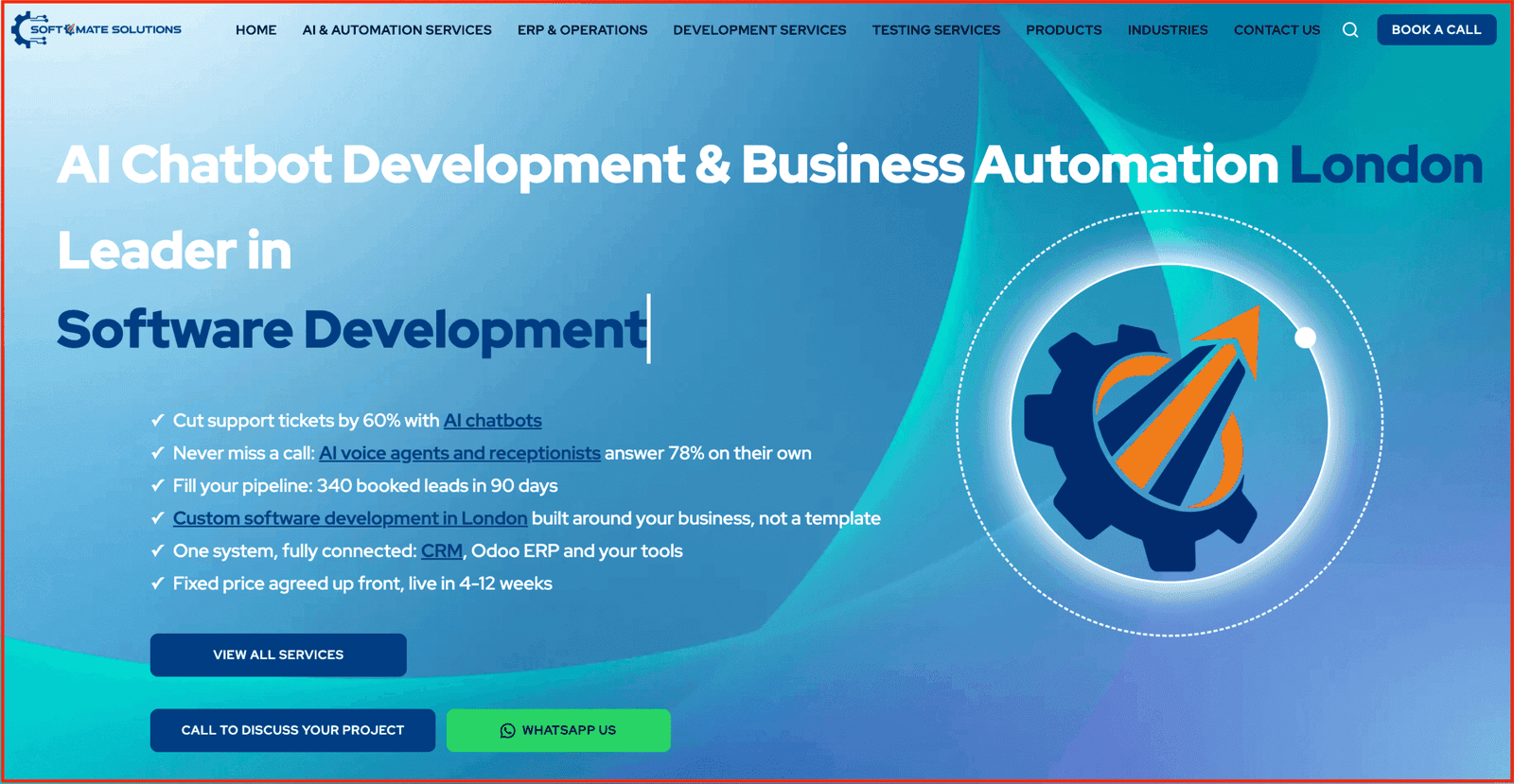
Softomate is a London-based automation agency that builds bespoke chatbots for UK businesses. Trained on your own product data, price lists, and FAQs rather than dropped in from a template. They lead with multi-channel: website chat, WhatsApp, Messenger, and SMS, wired into CRMs like HubSpot and Salesforce.
What stands out is how they package it for smaller businesses—fixed-price builds with UK GDPR compliance baked in and clear, sprint-based delivery. That makes them an approachable option for SMEs and trades who want a chatbot live without an open-ended enterprise engagement.
Best for: SMEs and trades wanting a fixed-price, multi-channel chatbot.
Key strengths:
- Bespoke chatbots across WhatsApp and web channels
- Fixed-price delivery with UK GDPR built in
- Fast, sprint-based builds suited to smaller teams
5. Konversable – Best for WhatsApp & Vertical Use Cases
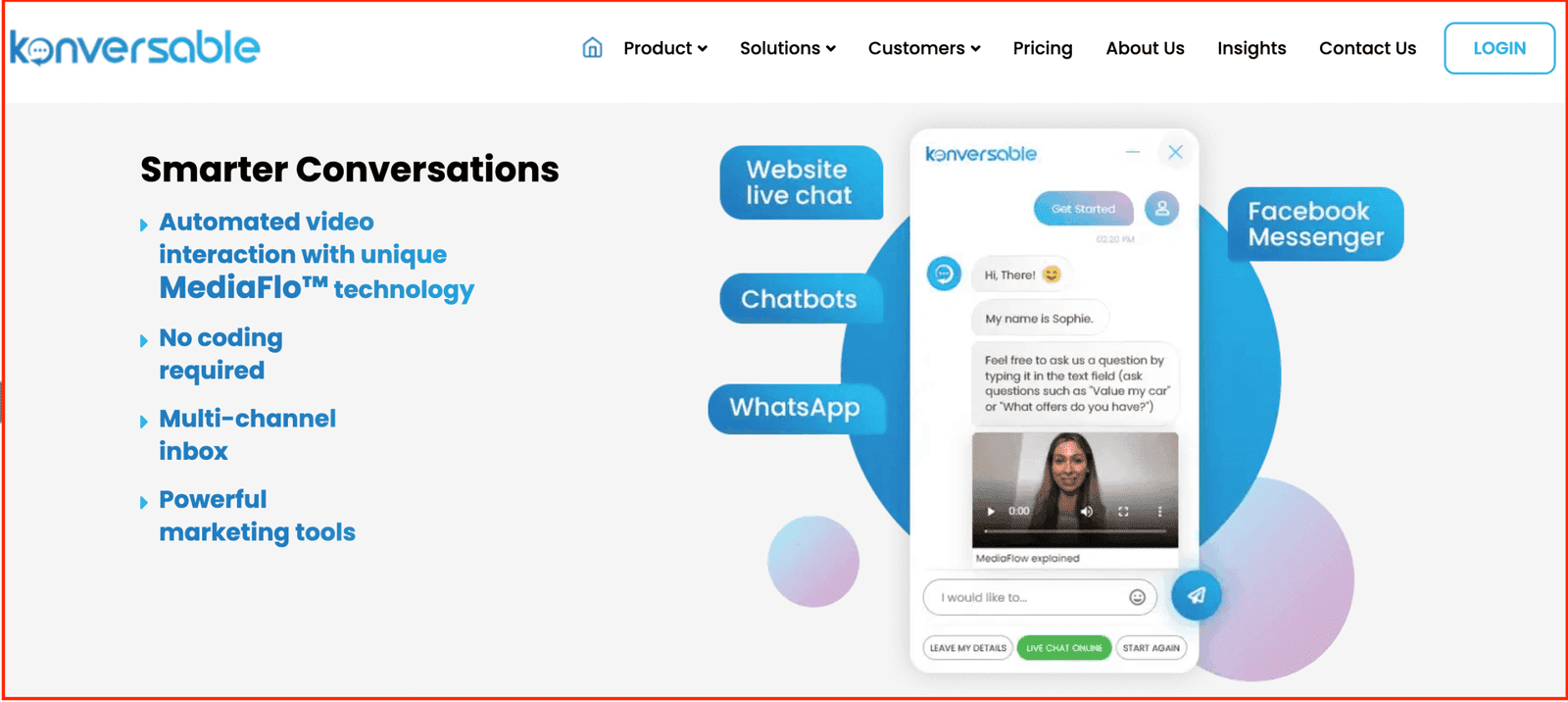
Konversable focuses on helping businesses have better conversations across live chat, WhatsApp, and Messenger. Rather than spreading across every kind of software build, they’ve gone deep on conversational messaging for specific verticals — automotive, dental, recruitment, property, and financial services.
That vertical focus is their edge. They ship industry-specific chatbot products with lead capture and WhatsApp Business built around how those sectors actually operate, all GDPR-compliant. If your priority is WhatsApp-led customer conversations in one of their core industries, they’re a natural fit.
The flip side is that a bespoke, data-trained build outside their productised model — say a complex internal automation bot — sits further from their core focus.
Best for: Businesses wanting WhatsApp-led chatbots in specific verticals.
Key strengths:
- Deep WhatsApp Business and live-chat expertise
- Industry-specific bots for sectors like automotive and property
- GDPR-compliant lead capture built in
6. Ronins – Best for Design-Led Chatbot Projects
Ronins is a creative digital agency that builds custom AI products — chatbots among them — with a real emphasis on conversational design. Their starting point isn’t the tech; it’s the person using the bot: who they are, what they’re trying to do, and how to get them there without friction.
That design-led lens is their signature. They map intent and dialogue flows carefully, tie the chatbot into your systems and brand voice, and choose the model that fits the job rather than forcing one. It’s a good fit if conversation quality and user experience are the priority — customer-facing bots where a clumsy exchange costs you.
Because they span web, apps, and brand work too, a chatbot often arrives as part of a broader product engagement rather than a standalone build.
Best for: Customer-facing chatbots where conversation quality matters most.
Key strengths:
- Design-led approach to intent and dialogue flows
- Chatbots tied into your systems and brand voice
- Model-agnostic — picks the right tech per project
7. Incepteo – Best for Mid Market AI Adoption
Incepteo is a product engineering firm that helps startups and established businesses build and scale software, with AI and chatbots as part of a broader, discovery-led offering. They’re ISO 27001 certified, so security and process sit near the centre of how they work.
Their more distinctive chatbot angle is internal process automation — bots that live inside your operational workflows rather than on your website. Think conversational layers over your CRM or ERP that let staff retrieve data, kick off processes, and handle approvals without hopping between systems.
If your goal is to reduce internal manual effort rather than build a customer-facing bot, that focus is a genuine fit. For a purely customer-facing, data-trained chatbot, a chatbot-first specialist may be the closer match.
Best for: Businesses automating internal workflows with conversational bots.
Key strengths:
- Internal process-automation bots over CRM and ERP
- ISO 27001-certified, security-conscious delivery
- Discovery-led approach across the wider build
8. Pixelette Technologies – Best for Budget Conscious Builds
Pixelette Technologies is an enterprise technology group that started in blockchain back in 2018 and has since spread into AI, agentic systems, and custom software. Chatbots are one strand of a wide portfolio, delivered by a 200-plus team across multiple countries, with ISO 27001 certification behind the work.
Their breadth is both the draw and the caveat. If you want a single partner covering AI, blockchain, and broader software under one roof — and value a firm with a strong, established review record — they’re worth a look.
But because AI chatbots sit alongside a lot of non-chatbot work, it’s worth checking their specific conversational-AI track record against a chatbot-focused team if the bot is your main priority.
Best for: Businesses wanting one partner across AI, blockchain, and software.
Key strengths:
- Broad AI, blockchain, and custom software capability
- Established, well-reviewed delivery track record
- ISO 27001-certified, enterprise-scale team
Ready to Build Your AI Chatbot?
From internal tools that automate your team’s admin to customer-facing support and lead-generation bots, we build the full range— from a simple FAQ assistant to an enterprise-grade system integrated across your stack. Whatever the use case, we build it to scale from day one.
And we don’t hand over demos or prototypes. We build production-ready AI chatbots that hold up with real users, real data, and real business conditions — the kind you can put live and trust.
If you’re exploring how to design and deploy a chatbot tailored to your business, QuantumXL can help you build scalable, production-ready AI solutions.
Talk to our team, and we’ll help you scope it.
About the author
Oliver Baker
Managing Director
I'm Oliver Baker, Managing Director of QuantumXL, a UK-based AI software development agency. For over a decade, I've helped founders, CTOs, and business leaders move AI from concept to production — working across startups, mid-market firms, and enterprise organisations to take real ideas off the whiteboard and turn them into systems that scale. I hold PRINCE2 and APM qualifications, bringing a structured, outcomes-driven approach to every engagement — and a commercial clarity that keeps AI projects tied to real business results.