

AI MVP vs Full Product: What to Build First and Why It Must Be Engineer-Built
Should you build an AI MVP or go straight to a full product? A UK AI development agency answers — with data on why vibe coding your AI MVP is the fastest way to build something that breaks in production.

On this page
- AI MVP or Full Product: The Decision Every UK Founder Gets Wrong
- When to Build an AI MVP First
- When AI is your real product
- When your runway depends on it
- When the market is dynamic and competitive
- When to Skip the MVP and Build the Full Product
- The Vibe Coding Problem: Why Most AI MVPs Are Built Wrong
- What vibe coding actually delivers
- The three specific ways vibe-coded AI MVPs fail in production
- Why AI MVPs specifically cannot be vibe coded
- What Engineer-Built AI MVPs Look Like and Why They Scale
- Data assessment before scoping
- Right model selection
- Architecture designed for production environments
- The Vibe Coding Sweet Spot: Where It Actually Belongs
- What a production-ready AI MVP actually requires
- The Cost Argument: Why Vibe Coding Your AI MVP Costs More in the End
- Funding Argument: Investors are Asking Harder Questions
- Build an AI MVP battle-tested for production environments
- How to Decide: A Framework for UK Founders
- Conclusion
If you’re an AI entrepreneur, you’ve probably already decided that an MVP makes sense before you commit the full budget. That’s the right instinct.
But here’s one decision that could make or break your idea before it takes off.
Are you going to build this MVP with AI vibe coding tools, or are you going to bring in experienced engineers who actually know how to build systems for real-world scenarios?
It is necessary that you make the right decision and proceed with caution because rebuilding the whole thing when investors and customers are watching.
AI MVP or Full Product: The Decision Every UK Founder Gets Wrong
Let’s be clear: an AI MVP is neither a prototype nor a demo. Also, it is vastly different from a standard MVP.
An AI MVP is the minimum working version that can validate your core hypothesis with real users using it under real conditions. This requires that the data be live and that the model perform without collapsing the infrastructure.
The crucial difference between an AI MVP and a standard MVP is this. A standard MVP tests whether users want your product. An AI MVP tests three additional things:
- Whether your data is good enough,
- Whether your model performs accurately enough, and
- Whether the infrastructure stays standing when people actually rely on it.
If an MVP can do all of these things, then isn’t it actually a working prototype?
I hear you. I’ve seen founders call something an MVP when it’s really a prototype. This Reddit user experienced it firsthand by building a prototype rather than an MVP.
Founders most often build something with vibe coding, which works well in a demo. However, in real user tests, it could break, requiring an extensive rebuild that would cost time and money.
The right MVP is one that doesn’t require rebuilding.
An MVP isn’t just a landing page. It’s the simplest working version of your product that solves one real problem and delivers value. Something users can actually use, and give feedback on. (Reddit)
When to Build an AI MVP First
There are three circumstances that warrant building the AI MVP first:
- When AI is your real product
- When your runway depends on it
- When the market is dynamic and competitive
When AI is your real product
Build the MVP first when the AI is actually your product, not a feature bolted onto something else. If your competitive advantage is the model, the accuracy, the data pipeline, then you validate that first. You don’t need a fully polished product. You need proof that the AI component works well enough that users will come back.
When your runway depends on it
Build it first when your runway depends on it. Most UK seed-stage founders are working on 12 to 18 months of capital. You can’t afford to build the full product, find out nobody wants it, and then have no money left for the pivot. An MVP that costs 30% of your runway to validate the core idea makes sense.
When the market is dynamic and competitive
Build it first when the market is moving fast and being early matters more than being perfect. AI is one of those categories where first-mover advantage is real. If your market window is six months, not two years, the MVP gets you in the game.
Most investors in the UK take anywhere from 6 months to 2 years before writing a check.
So it is necessary to have a working MVP to demonstrate market feasibility before going too far with AI product development.
When to Skip the MVP and Build the Full Product
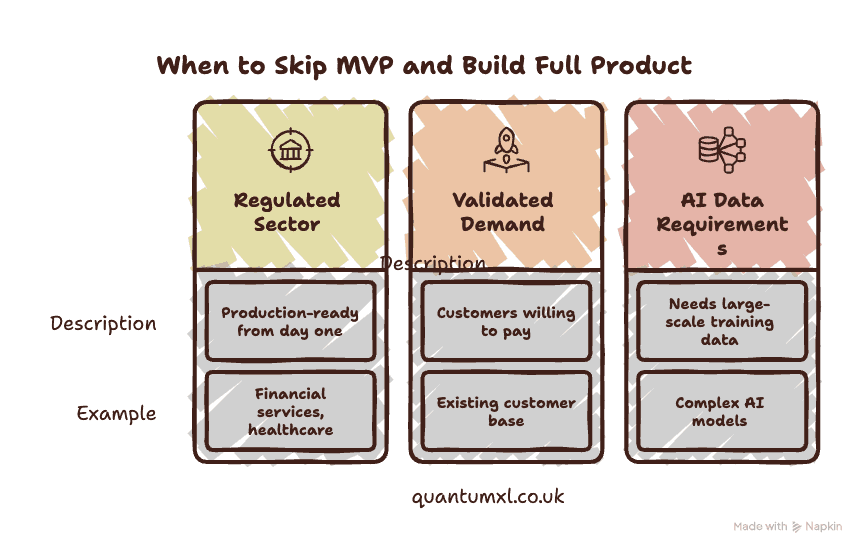
Sometimes it is ideal to skip the MVP altogether and build the full product. Although this might seem counterintuitive, it is necessary, especially under these circumstances:
- You’re in a regulated sector that requires you to be production-ready from day one. For example, financial services and healthcare, where regulatory bodies require you to demonstrate security, compliance, and governance at all times.
- You have already validated the demand, and you have customers who are willing to pay
- When the AI capability you’re building requires more data than an MVP stage can handle. Some models need training data at a scale that a startup simply can’t reach in month one. If that’s your situation, you either build to scale from the start or you wait until you have the data.
The Vibe Coding Problem: Why Most AI MVPs Are Built Wrong
We have heard umpteen times from founders that vibe coding has given them a free runway to build everything they want. This has also led to a slew of AI MVPs being launched quickly.
However, there are several blind spots these vibe-coding founders are overlooking. Most founders fail to understand the fine difference between when to use vibe coding and when to bring senior engineers. The difference in AI MVP performance and code quality is immense.
First, we need to explore in detail what vibe coding actually delivers.
What vibe coding actually delivers
There are three things that vibe coding delivers:
- Speed
- Demos that (barely) work
- Code that looks finished
However, behind these three curtains are serious vulnerabilities. A product that is programmed through keyboard racing is worth nothing if it doesn’t work. A demo that barely works but will fail in production is no demo at all. A code that looks finished but is riddled with security vulnerabilities is a black hole.
We have enough real-world case studies to prove why vibe-coded AI MVPs could invite disaster if not handled carefully.
In December 2025, CodeRabbit analyzed 470 real GitHub pull requests comparing AI-generated code to human-written code. The analysis found that AI-generated code introduces 1.7 times more major issues. What’s more concerning is that AI code is 2.74 times more likely to introduce cross-site scripting vulnerabilities, highlighting serious security concerns.

Further, at least 75% of them had logic errors and there was an 8x increase in performance problems. The obvious takeaway was that AI-generated code creates more technical debt.
The three specific ways vibe-coded AI MVPs fail in production
There are three specific ways vibe-coded AI MVPs fail when they meet real users:
1. Security vulnerabilities that pass your internal tests and only surface when someone with actual malicious intent probes your system or when your load increases beyond what you tested.
In May 2025, researcher Matt Palmer disclosed CVE-2025-48757 in Lovable, a popular AI app builder. He found that 170 out of 1,645 analyzed projects had inadequate database security configurations.
That’s 10% of their showcase apps, the ones they actually promoted as examples, leaking sensitive data like names, emails, API keys, and payment information without anyone knowing. All accessible because the security layer that should have been invisible infrastructure got skipped, because it’s not visible in a demo.
2. Architecture cannot scale under real-world scenarios.
3. AI-generated code is usually a black box that human programmers cannot easily break down and fix when things go wrong.
Why AI MVPs specifically cannot be vibe coded
The primary reason AI MVPs specifically cannot be vibe-coded is that they have unique production requirements. An AI vibe coding tool cannot understand your data pipeline integrity requirements, think through model accuracy thresholds or estimate architecture needs and costs as the product scales.
In our experience building production AI systems for companies like Siemens Healthineers and AkzoNobel, the architectural decisions that determined whether those systems would survive real-world conditions were made before a line of code was written.
At Quantum XL, a tool doesn’t make those decisions; our senior AI engineers do.
What Engineer-Built AI MVPs Look Like and Why They Scale
AI engineers can anticipate challenges that will arise as the product scales. They build robust AI applications that will not break when the load increases.
Here is how AI MVPs scale:
- Data assessment before scoping
- Right model selection
- Architecture designed for production environments
Data assessment before scoping
Experienced engineers building AI MVPs always get an idea of what data your AI actually needs to function. This happens even before a single line of code is written.
They also estimate how much of the existing codebase can be reused and prepare an accurate assessment of new code to be written, purchased, or cleaned.
Unfortunately, most vibe-coded projects skip this and just assume the data they have is good enough, which is rarely the case.
Right model selection
New founders are prone to fall for the glitz and glamor of trending data models. Whereas a senior engineer thinks differently.
What’s the right data model for the desired output we’re trying to produce?
What are our latency requirements and our cost constraints?
Sometimes a small fine-tuned model is sufficient for this use case. Or maybe an older, simpler model already exists that can be used after some data cleansing.
In short, the most trending, largest, and most used data model may not always be the right choice.
Architecture designed for production environments
An engineer-built AI MVP will be built on an architecture that will work under all production environments. The data pipeline integration, how inference is served, and how model degradation is measured are all considered by engineers. These proactive decisions save a lot of time in retrofitting features or rebuilding infrastructure.
A production-ready AI MVP requires clean data pipelines connected to live business data. It cannot function with sample data that performs well in demos but crashes during real user tests.
Further, it requires accuracy benchmarks and a robust deployment infrastructure, both of which are crucial architectural decisions that only a seasoned senior engineer can make.
The Vibe Coding Sweet Spot: Where It Actually Belongs
Vibe coding has been defamed unfairly since its introduction. Vibe coding is not a bad thing at all if it is used properly in the early exploration stage of the product. In fact, it is beneficial for founders to use vibe coding before committing significant engineering resources.
It will help provide quick answers to existential questions like:
Is this idea worth building?
Can the AI do it with better accuracy?
However, using vibe coding in deployment is a recipe for disaster. They cannot be trusted with handling real user data. The moment these systems are entrusted with real-world data, the risks of things going wrong and landing the startup in a legal quagmire are high. It is here that the skills of an experienced engineer come in handy.
A sharp founder will know this split between when to use vibe coding and when to count on senior engineers.
What a production-ready AI MVP actually requires
Three specific things separate an AI MVP that will survive users from one that breaks.
Clean data pipeline
A clean data pipeline connected to live business data. This is one of the basic requirements for any AI MVP that, unfortunately, most founders get wrong.
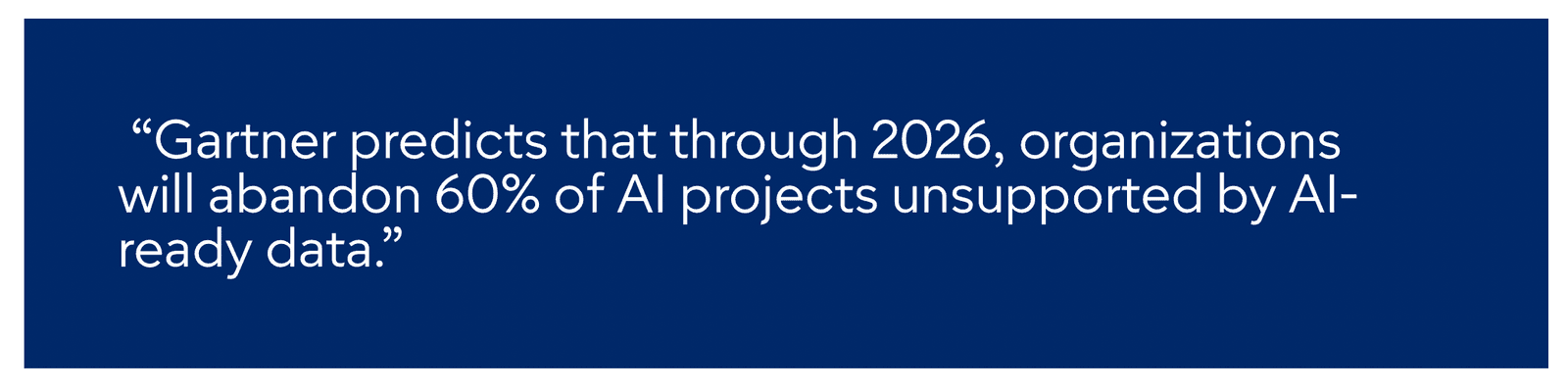
Gartner predicts that through 2026, 60% of AI projects will be abandoned due to inadequate data foundations.
Accuracy benchmarks
Given that the expected outcome is an AI MVP, what is the accuracy benchmark?
Does a 90% accuracy look good to proceed or is it absolutely necessary to ensure 99% accuracy to justify making further investments?
The decision on accuracy benchmarks could decide the product’s fate. For example, in a tightly regulated market like BFSI, a 90% accuracy is sub-par and will be considered non-compliant, whereas in retail it may be considered ideal (under specific circumstances).
Deployment infrastructure
Finally, the deployment infrastructure monitors whether the model continues to perform correctly. This infrastructure, which might be brand new and working fine in the initial stages, could deteriorate as new data is introduced, user behavior patterns are ingrained, or when real-world use deviates.
This is why an engineer-built AI MVP costs more upfront and saves money overall. The senior engineer is not keen on adding features. Instead, they are taking long-term measures to ensure that the MVP can be built into a real market-ready product.
The Cost Argument: Why Vibe Coding Your AI MVP Costs More in the End
Most founders wrongly assume that they can build AI MVPs using vibe coding and save money. However, most vibe-coded AI MVPs that find product-market fit require partial or full rebuilds before they can scale.
And these rebuilds cost more than the original build. To make things worse, it happens at the worst possible time, when you have live users and investors closely watching how the product is working.
UK senior AI engineers cost between £80,000 and £150,000 per year, or roughly £80 to £200 per hour as a day rate. A vibe coding tool costs £20 to £200 per month. The math might look favorable for vibe coding until you start rebuilding and expending too many AI tool tokens.
Funding Argument: Investors are Asking Harder Questions
Investors in 2026 are asking harder questions about AI technical architecture during due diligence. They are curious about how AI is integrated into the product, the models it uses and how business workflows work with third-party tools.
A vibe-coded codebase that your team cannot fully explain can dissuade any investor. It breaks their confidence and makes them wary of investing.
Compared with these drawbacks, an engineer-built AI MVP comes with a documented architecture. It uses clean data pipelines, measures against performance benchmarks, and uses a codebase that the team can explain with confidence.
In other words, the small premium you pay at the MVP stage typically buys you 6 to 12 months of additional runway before you hit the scaling problems that vibe-coded systems hit in month four.
Build an AI MVP battle-tested for production environments
QuantumXL scopes, builds, and stays accountable for your MVP delivery.
How to Decide: A Framework for UK Founders
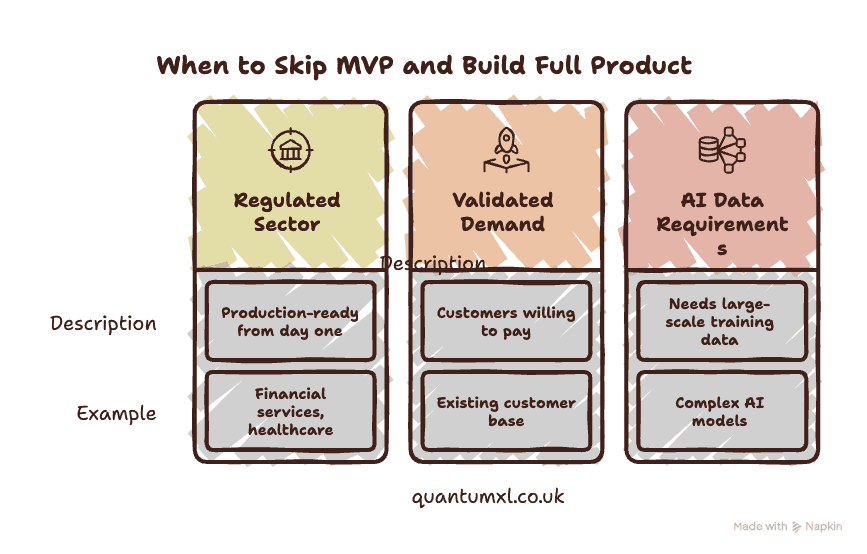
With so much information and variables, it can be difficult even for a startup with good judgment to make a decision.
Use this framework to simplify your decision-making about whether to build or vibe-code your AI MVP.
Question | Vibecoded | Engineer-Built |
|---|---|---|
Is the AI your product or a feature? | If AI is a feature you’re adding to something else, vibe code the exploration first. Validate that the AI layer adds value, then bring in engineers for the real version. | If AI is your core value proposition, you cannot vibe code your competitive advantage. Engineer from day one. |
Does this system handle real user data? | If you’re working with public data, demo data, or low-risk information, you have flexibility with vibe coding. | If it’s private data, payment info, health records, or anything sensitive, engineer at any cost. One breach costs more than an engineer’s year. Security cannot be bolted on later. |
Can your runway survive a rebuild? | If yes, you can vibe code, though you’ll incur technical debt that you’ll pay later when you scale. | If not, you must engineer to keep costs controlled and avoid the rebuild risk that your finite runway cannot absorb. |
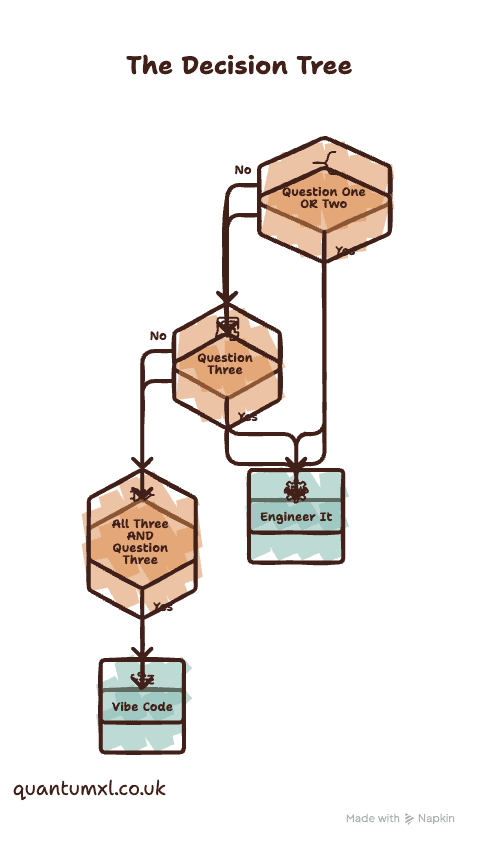
The Decision:
Yes to Question One OR Two = engineer it. Non-negotiable.
No to Question Three = engineer it. Your runway constraint forces this choice.
No to all three AND Yes to Question Three = you can vibe code. Even then, you’re taking technical debt you’ll pay later.
Conclusion
It is clear from all the discussion that building an AI MVP first is the right move. You must validate before you scale.
Also, we have clarity on whether it should be vibe coded or engineer-built. If it needs to survive production, handle real data, or your runway depends on you getting it right the first time, you engineer it.
Remember that the founders who win are not the fastest to demo. The founders who can build an AI MVP that does not show cracks under pressure and can explain their architecture are the ones who succeed.
About the author
Devon Ray
Technical Director
I'm Devon Ray, CTO and Technical Director at QuantumXL. I've spent over a decade building AI-powered software systems for businesses across the UK. I’ve been working with founders who need to ship their first intelligent product, and enterprise teams who need AI that integrates, scales, and holds up under real operational pressure. What I enjoy most is the hard problems. The ones where the gap between a promising AI concept and a system that actually works in production is wider than anyone expected. That's where I spend most of my time — and where QuantumXL does its best work.