

5 AI Development Companies in the UK, Compared 2026: Which One Fits Your Project?
Compare 5 AI development companies in the UK for 2026, mapped by use case, scale and specialism, from startups to enterprise.

On this page
- Key Takeaways
- TLDR; 5 AI Development Companies in the UK Compared
- The 5 AI Development Companies Compared in Detail
- 1. QuantumXL — Best for End-to-End AI Development, Concept to Production
- 2. Thoughtworks – Best for Enterprise-Scale AI Transformation
- 3. Faculty AI — Best for Data Science and Decision Intelligence
- 4. Elsewhen — Best for AI Product Strategy and Experience
- 5. Limeup – Best for Fintech and Regulated, Data-Heavy AI
- Final Thoughts: Choosing the Right AI Development Partner
Key Takeaways
- Thoughtworks is best for enterprise-scale AI transformation, while Faculty AI is the go-to for data science and decision-intelligence systems.
- QuantumXL is best for founders and technical teams that need end-to-end AI development — taking a product from concept through to production and scaling it from there.
- Elsewhen is best for product and leadership teams shaping customer-facing AI where strategy and experience come first.
- Limeup is perfect for fintech and data-heavy startups building AI in regulated, compliance-driven environments.
The UK now has more AI development companies than any buyer can reasonably assess. Most pitch the same three things: an experienced team, end-to-end delivery, production-ready systems.
That sameness is the real problem. When every firm sounds identical, the differences that actually decide a project — use case, scale, and how far you are into the build — get buried.
This comparison maps five UK firms to the work they genuinely do best. Read it to turn a long list into a shortlist you can act on.
TLDR; 5 AI Development Companies in the UK Compared
Not every AI partner fits every project. This table maps each firm to where it delivers most — so you can match your use case, scale, and build stage before reading further.
Company | Best for | Org size | Engagement | Core strength |
|---|---|---|---|---|
QuantumXL | End-to-end AI product development | Startup → Enterprise | Long-term build partner | Concept-to-production delivery |
Thoughtworks | Enterprise AI transformation | Large enterprise | Multi-phase programme | Large-scale system integration |
Faculty AI | Data science & decision intelligence | Enterprise | Project-based | Advanced modelling & analytics |
Elsewhen | AI product strategy & experience | Scaleup → Enterprise | Strategy & design phase | AI-led product design |
Limeup | Fintech & regulated data | Startup → Scaleup | Product build | Financial-systems AI |
The 5 AI Development Companies Compared in Detail
Each firm below is mapped to the work it does best — who it suits, where it’s strong, and what to weigh before you commit.
Read the one that matches your stage, then compare it against the next. The goal is a shortlist you can defend, not a longer list to wade through.
1. QuantumXL — Best for End-to-End AI Development, Concept to Production
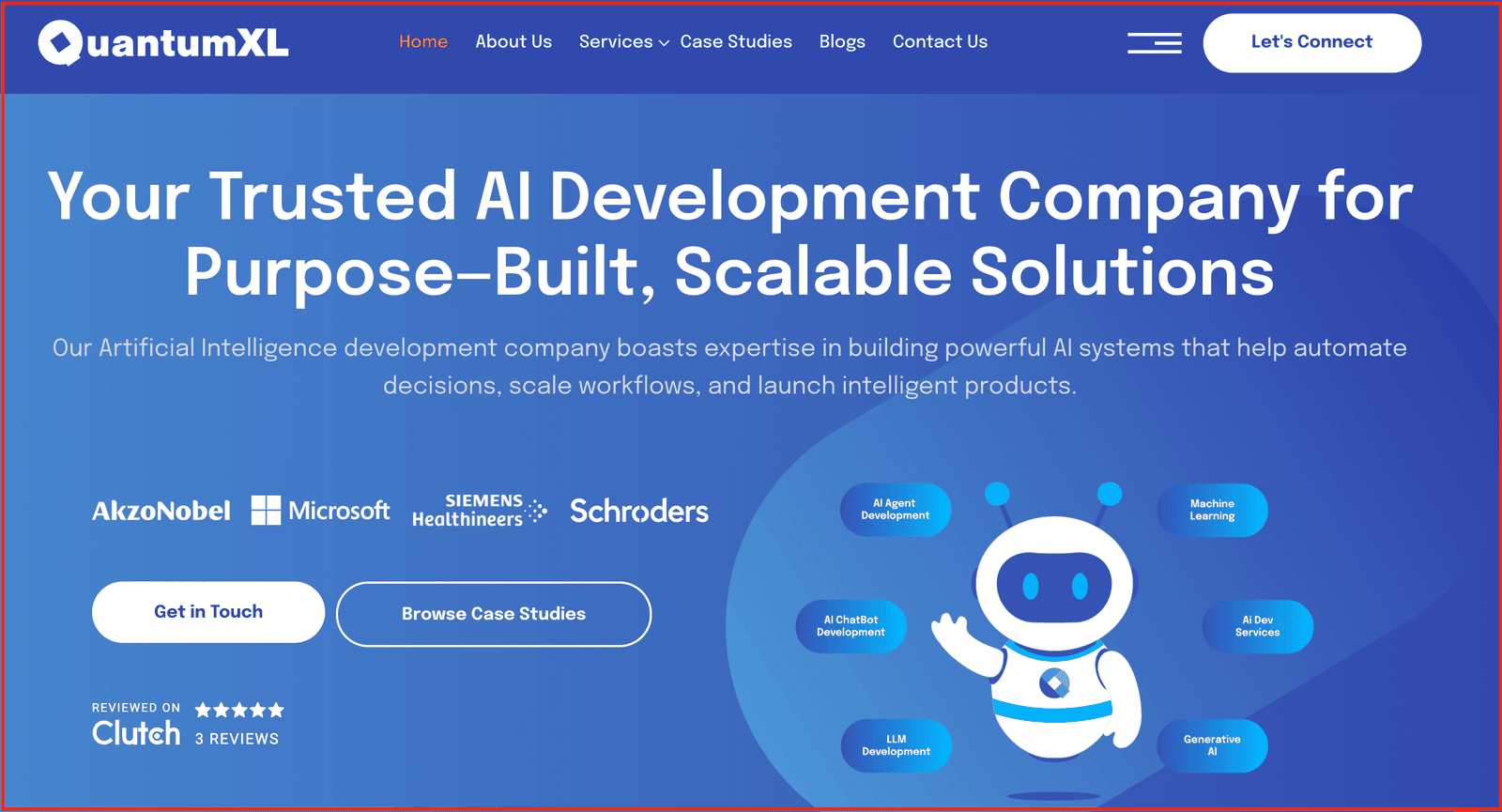
Most AI projects don’t fail on strategy. They fail at the build — when a sound use case has to become a system that runs in production, integrates with existing tools, and holds up at scale.
QuantumXL is built for exactly that handover. The same senior Manchester-based UK AI engineering team that scopes the work, engineers and ships it, so nothing gets lost between strategy and delivery.
For founders, that means moving from an idea to a working AI product without having to rebuild later.
For enterprises, it means systems that meet governance and data requirements from day one.
Who it suits: Founders and technical leaders who need a partner to take an AI initiative from concept through to production — and keep it running as it scales.
Strengths
- Full lifecycle delivery, from scoping and architecture to deployment
- Senior-led at every stage, with no outsourced layers
- Deep capability across modern AI systems, including LLMs, AI agents, and computer vision
- Responsible AI built into the process, not bolted on at the end
Things to consider
- Best suited to organisations with a defined use case ready to build
- Works best when objectives are aligned before the engagement begins
Verdict: Pick them if you need concept-to-production AI development under one roof. Skip them if you want a pure staff-augmentation team to slot under your own leads.
You can see how we approach it, from scoping through to production, their AI development services or start a conversation on a discovery call.
2. Thoughtworks – Best for Enterprise-Scale AI Transformation
Thoughtworks earns its place when the scope runs past a single product build. It works with large enterprises on complex transformation programmes, where AI must land across multiple systems, teams, and regulatory environments simultaneously.
The strength is depth at scale: structured delivery, serious engineering discipline, and experience in distributed organisations where stakeholder alignment matters as much as the code. This is not a startup partner. Engagements are longer, more structured, and built for internal complexity.
Who it suits: Large enterprises running multi-phase programmes that put AI to work across the organisation.
Strengths
- Extensive experience with enterprise-scale systems
- Strong engineering culture and delivery rigour
- Proven at managing AI integration across complex environments
- Deep bench for distributed, multi-team programmes
Things to consider
- Less suited to fast-moving startup builds
- Engagements run longer and more structured by nature
Verdict: Pick them if you’re an enterprise running AI across the whole organisation. Skip them if you need a lean team moving at startup pace.
Before you commit to anyone here, run them through our guide to choosing an AI development company — the criteria hold whoever makes your shortlist.
3. Faculty AI — Best for Data Science and Decision Intelligence

Faculty comes into focus when the challenge is pulling consistent value from large, complex datasets. It applies advanced data science to build predictive models, decision systems, and analytics platforms — helping organisations spot patterns, forecast outcomes, and sharpen operational performance.
The work spans pricing optimisation, demand forecasting, and risk modelling. The focus is solving high-impact problems through modelling, not shipping customer-facing products.
Who it suits: Enterprises with significant data assets that need advanced modelling and decision-intelligence systems.
Strengths
- Deep expertise in applied data science and AI modelling
- Strong record on complex, data-heavy problems
- Focus on decision systems over general-purpose applications
- Analytical rigour suited to high-stakes forecasting
Things to consider
- Less geared to end-to-end product development
- Best for data-driven problem-solving over full builds
Verdict: Pick them if your problem is modelling-related. Skip them if you need a product built and shipped around it.
4. Elsewhen — Best for AI Product Strategy and Experience
Elsewhen matters when the priority is building the right AI product, not just an AI product. It works with enterprises and scaleups to shape how AI fits into customer-facing products and digital experiences — starting with strategy and design before a line of code is written.
The approach centres on usability and alignment. AI is treated as a product capability, not a technical feature — which counts when what you build has to deliver real value to end users, not just work in a demo.
Who it suits: Product and leadership teams building customer-facing AI that need strategy, design, and experience to pull in the same direction.
Strengths
- Strong expertise in AI product strategy and experience design
- Clear focus on aligning AI capability with real user needs
- Effective at setting product direction before development starts
- Design-led thinking that keeps the end user central
Things to consider
- Less focused on deep engineering or infrastructure-heavy builds
- Often works best alongside an engineering-led delivery partner
Verdict: Pick them if your first question is what to build and why. Skip them if the design is settled and you need it engineered and shipped.
5. Limeup – Best for Fintech and Regulated, Data-Heavy AI
Limeup sits at the intersection of financial systems, data, and product development. It builds AI-driven products for fintechs and data-heavy platforms, where precision, compliance, and performance aren’t negotiable.
The domain focus is the differentiator. Rather than pitching as a broad AI firm, it brings specific experience in financial systems and regulated environments — which cuts risk and the learning curve on projects where sector knowledge is the whole game.
Who it suits: Startups and scaleups in fintech, or adjacent sectors, that need AI built around financial systems and regulatory requirements.
Strengths
- Strong focus on fintech and data-centric applications
- Proven in regulated, compliance-driven environments
- Product-oriented approach to AI development
- Sector fluency that shortens discovery
Things to consider
- More specialised than a general-purpose AI firm
- Best for fintech and data-heavy use cases
Verdict: Pick them if your build lives in a regulated financial environment. Skip them if your project sits outside that domain.
Final Thoughts: Choosing the Right AI Development Partner
The best AI development companies don’t lead with technology. They lead with your problem — what success looks like, what the system has to do in production, and what happens when it scales.
Use this comparison as your starting point. The right choice comes down to your use case, your stage, and what you need the system to actually deliver.
Ready to build?
If your shortlist includes a partner for end-to-end AI development, the fastest way to test fit is a conversation.
Book a discovery call with QuantumXL today and pressure-test your use case before you commit to anyone.
About the author
Oliver Baker
Managing Director
I'm Oliver Baker, Managing Director of QuantumXL, a UK-based AI software development agency. For over a decade, I've helped founders, CTOs, and business leaders move AI from concept to production — working across startups, mid-market firms, and enterprise organisations to take real ideas off the whiteboard and turn them into systems that scale. I hold PRINCE2 and APM qualifications, bringing a structured, outcomes-driven approach to every engagement — and a commercial clarity that keeps AI projects tied to real business results.