

How to Choose an AI Development Company in the UK — A 2026 Buyer's Guide
Choosing an AI development company in the UK? Real 2026 costs, current EU AI Act rules, and an agency's evaluation scorecard.

On this page
- Before You Start Evaluating AI Development Companies in the UK
- 1. Start With the Business Problem, Not the AI Solution
- 2. Define the Constraints — and the Budget — Before the Solution
- 3. Make Sure Your Organisation Is Ready to Own AI
- Why Choosing an AI Development Company Is Different From Choosing a Software Company
- 1. Software Delivers Features. AI Delivers Probabilities.
- 2. Your Data Matters More Than the Model You Pick
- 3. AI Projects Don’t End at Deployment. They Start There.
- The 7 Criteria for Evaluating an AI Development Company
- 1. Do They Start With Your Business Problem or Their Technology?
- 2. Do They Validate Your Data Before Recommending a Solution?
- 3. Can They Explain Why This Is the Right Technical Approach?
- 4. Have They Taken AI Systems Beyond the Prototype Stage?
- 5. Is Governance Built Into Their Delivery Process?
- 6. What Happens After the AI System Goes Live?
- 7. Can They Deliver Within Your Business Constraints?
- 5 Common Mistakes to Avoid When Choosing an AI Development Company
- 1. Hiring the Best Demo Instead of the Best Delivery Team
- 2. Assuming Your Data Is Ready for AI
- 3. Mistaking a Prototype for Production Experience
- 4. Accepting a One-Size-Fits-All AI Strategy
- 5. Treating Deployment as the Finish Line
- How to Make the Final Decision While Choosing Your AI Development Partner
- 1. Compare Evidence, Not Proposals
- 2. Pay Attention to the Questions They Ask
- 3. Choose the Partner Who Removes the Most Uncertainty
- What to Do Next
Every UK business chasing AI right now is asking the same question: how do you choose an AI development company you can actually trust with the build?
The market is full of AI development companies with slick demos and long client lists. Almost none of that tells you who will still be answering your calls 6 months after launch.
This guide gives you the evidence that predicts real delivery success: the realistic UK costs, the questions serious AI development companies answer without flinching, and the mistakes that sink most projects before they ship.
By the end, you’ll know exactly what separates a capable AI development company from a risky one.
Before You Start Evaluating AI Development Companies in the UK
Do this groundwork first, and every agency conversation after it gets sharper.
1. Start With the Business Problem, Not the AI Solution
The earliest mistake is deciding you need AI before defining what you’re solving — that pulls the conversation into models and features before anyone’s agreed what success looks like.
Start with the operational problem instead: you’re not trying to build a chatbot; you’re trying to cut response times or reduce costs.
Many businesses start with a short AI consulting services engagement to pressure-test the business case before committing to development spend.
Before talking to an agency, answer one question: what business metric should move if this project works? If you can’t answer that, you’re comparing proposals, not outcomes.
Research from UK consultancy Emergn found large UK businesses lose an estimated £67 billion a year on AI and transformation work that fails to deliver. The cause is weak oversight, not under-investment. Only 30% of the 700 leaders surveyed consider it normal to stop a failing program.
2. Define the Constraints — and the Budget — Before the Solution
Once the problem is clear, set the boundaries within which the solution must work: existing systems, timeline, regulations, and budget.
UK AI pricing spans a wide range. A proof of concept or single-workflow tool typically costs £10,000–£35,000 and takes 6–10 weeks.
A production-grade feature — a chatbot with real business logic and a recommendation engine — runs £40,000–£150,000 over 3–6 months; our chatbot cost breakdown explains what drives that range.
A full enterprise platform typically starts around £150,000 and can exceed £500,000.
These ranges are a sense-check, not a quote. The bigger risk is what’s missing: data preparation and compliance work routinely add 35–50% on top.
Ask any agency what their quote includes and excludes.
A good AI software development company uses your constraints to rule things out before proposing anything.
3. Make Sure Your Organisation Is Ready to Own AI
Picking the right agency won’t fix a lack of ownership on your side. Before agency conversations start, decide who makes the calls, who provides data access, who validates outputs, and who owns the system after it ships.
AI doesn’t stop needing attention at launch. Models need monitoring. Knowledge bases need updating. The business keeps changing around the system. If nobody owns that, accuracy and relevance quietly erode — not because the technology failed, but because nobody was watching it.
The businesses that get long-term value from AI aren’t necessarily the ones who picked the best agency. They’re the ones who’d already sorted out internal ownership before a single line of code was written. That distinction is easy to overlook during agency selection and expensive to discover afterward.
Why Choosing an AI Development Company Is Different From Choosing a Software Company
Most businesses evaluate AI development agencies the way they’d evaluate any software company — on demos, delivery timelines, and portfolio.
That worked when a project shipped fixed, predictable functionality.
AI doesn’t behave that way: it depends on data quality, needs ongoing evaluation, and keeps changing after it ships, which means the evaluation has to change too.
1. Software Delivers Features. AI Delivers Probabilities.
Traditional software behaves the same way every time, given the same input. AI doesn’t — it produces outputs based on patterns and probability, which means “it works” isn’t enough. You need to know it’s accurate, reliable, fair, and useful to the business before you trust it with anything real.
That changes what you’re actually checking for in an agency. You’re not just asking whether they can build the feature. You’re asking whether they can define what “acceptable” looks like, test edge cases, and explain how the system behaves once real users and messy data get involved — because a demo running on clean, curated inputs will always look better than it performs in production.
The ICO is direct about this in its guidance on statistical accuracy: AI systems processing personal data need controls to ensure outputs remain sufficiently accurate. The question for an agency isn’t “does the demo work” — it’s “how do you validate performance before and after launch?“
2. Your Data Matters More Than the Model You Pick
Businesses spend more time comparing models than checking whether their data can actually support any of them. In practice, data quality and governance decide the outcome far more than which model or framework gets chosen.
Take two retailers running the same demand-forecasting tool. One has years of clean, consistently categorised sales data. The other has incomplete records scattered across three disconnected systems. Same model, same agency, different results — because the data was the constraint, not the algorithm.
This is where many AI proposals quietly mislead.
An agency can show you an impressive model architecture without ever asking what your data actually looks like, and the gap between the two only becomes apparent once development is already underway and the results start to disappoint.
So before comparing technical proposals, ask each agency:
- how they assess data readiness
- what they’d need to see before recommending anything
That answer tells you more than the model they propose.
3. AI Projects Don’t End at Deployment. They Start There.
A working proof of concept proves an idea is possible. It doesn’t prove the system holds up against real users, shifting requirements, and evolving data — production is where the real risk shows up, often months after everyone’s stopped paying attention.
Unlike traditional software, AI needs ongoing monitoring, evaluation, and governance to stay accurate.
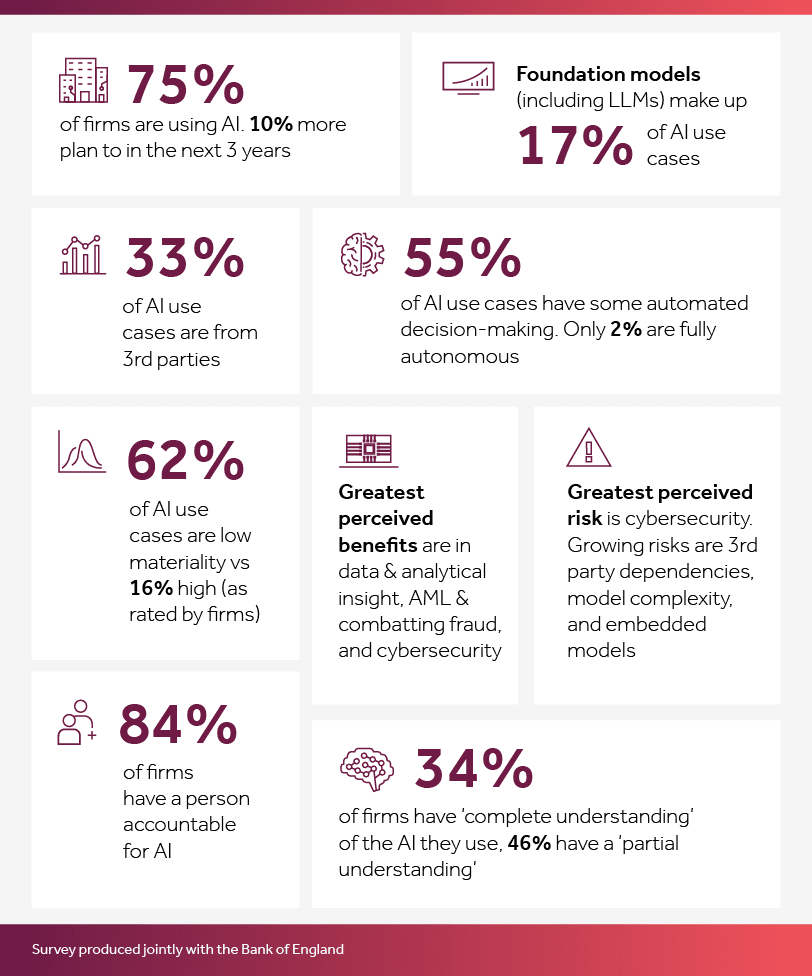
UK regulators are already treating this as a live priority, not a hypothetical one: the FCA reports that 84% of financial services firms now have a named individual accountable for their AI approach, and it’s launched AI Live Testing specifically to evaluate how systems perform under real-world conditions after launch, not just in a lab.
So don’t ask a vendor what happens on launch day. Ask what happens 6 months later. That answer tells you whether you’re hiring a delivery partner or a one-off supplier.
The 7 Criteria for Evaluating an AI Development Company
Every AI agency will tell you it has the expertise to deliver. The problem is telling which claims are backed by evidence, rather than confidence.
These 7checks are the evidence that actually predicts whether the agency will follow through — not what they say in a pitch, but how they behave before you’ve signed anything.
1. Do They Start With Your Business Problem or Their Technology?
Watch the first hour of the discovery call closely. If it shifts straight to models, frameworks, or which LLM they prefer working with before your business objectives are even nailed down, you’re being sold a solution — not given advice.
A capable partner starts by:
- understanding what you’re trying to achieve
- why it matters to the business
- how you’ll measure success
- whether AI is even the right route
Sometimes it isn’t. A business trying to fix slow customer support might need workflow automation, or better internal documentation.
The right call depends entirely on the outcome you’re chasing, not on whichever technology the agency happens to specialise.
A company that leads with technology often sells what it already has. A company that leads with your problem is prepared to tell you AI isn’t the answer, even if that costs them the deal.
The tell: before technology comes up at all, the company should be asking hard, specific questions about your objectives, your operational pain, and how you’ll actually measure value once the system is live.
2. Do They Validate Your Data Before Recommending a Solution?
Plenty of AI projects run into trouble before development even starts because nobody checks whether the data can support what’s being proposed. It’s still common to compare models and architectures before anyone’s confirmed the underlying data is actually fit for the job.
A serious agency checks the quality, accessibility, governance, and completeness of your data before recommending an architecture — not after the contract is signed.
If customer records are scattered across disconnected systems or riddled with duplicates, fixing that foundation might matter more to the outcome than picking a more sophisticated model.
This conversation belongs in discovery, not in a change request three months into the build. If an agency is ready to recommend an approach before they’ve asked to see a sample of your actual data, that’s not confidence — it’s a guess with better production values.
What good looks like: they check your data before they propose anything, flag the risks they find honestly, and tell you plainly what needs fixing before work begins.
3. Can They Explain Why This Is the Right Technical Approach?
A good AI development company doesn’t start with a favourite model. It starts with the problem, weighs a handful of genuinely different technical approaches, and picks whichever balances performance, cost, scalability, governance, and long-term maintainability — then can tell you why the others didn’t make the cut.
A customer support assistant might be better served by retrieval-augmented generation against trusted internal knowledge than by a general-purpose chatbot.
A forecasting platform might need predictive machine learning trained on your own operational history rather than a generic off-the-shelf model.
The right answer carries the least operational risk for your specific business — not whichever technology is newest, or whichever the agency happens to have pre-built.
Worth watching for here: a growing number of agencies are simply wiring together existing tools — an API call to a foundation model, a bit of prompt engineering — and presenting it as custom AI development.
That’s not necessarily wrong for a simple use case, but it’s a different engagement entirely from one built around your own data and architecture, and it should be priced and scoped differently too.
Ask directly which one you’re actually being sold.
The giveaway: they can tell you, unprompted, what alternatives they considered and why they ruled them out.
4. Have They Taken AI Systems Beyond the Prototype Stage?
A proof of concept proves an idea is technically possible. It doesn’t prove a system holds up against real users, production data, and shifting requirements — integration, monitoring, security, and resilience only show up once something’s actually live.
This is where the gap between “we built a demo” and “we run this in production” becomes obvious, and where many agencies go quiet.
Ask for examples of systems an agency has taken into production, not pilots.
We’ve done this ourselves — our computer vision system for Siemens Healthineers automated a manual MRI calibration check that technicians previously did by eye, and we built and delivered it for real-world use in their field-service workflow, not a lab demo.
DSIT’s analysis identified an estimated 161 UK-based AI assurance firms, with 80% of the specialised ones showing growth signals. Independent verification of production AI has become an industry in its own right, precisely because production is where things go wrong.
What good looks like: real deployment examples, a clear account of post-launch monitoring, and honesty about what they got wrong the first time.
5. Is Governance Built Into Their Delivery Process?
Governance shouldn’t turn up at the end as a compliance box-tick. It should shape decisions from day one — how data is accessed, how outputs are validated, how AI-driven decisions are reviewed. Retrofitting this after deployment is far more expensive than designing for it from the start.
This isn’t a hypothetical gap. DSIT’s 2025–26 survey of UK businesses found that 17% of AI-using businesses have no AI governance policy, and only 46% find the ICO’s regulatory guidance clear and easy to understand.

Most agencies won’t be more disciplined than their clients unless governance is built into how they work, not bolted on because a client asked.
Ask specifically about the EU AI Act, even if you’re UK-only. Most still quote a blanket August 2026 deadline — that’s now out of date. Transparency requirements still apply as of 2 August 2026, but the toughest high-risk obligations were deferred to December 2027 following a May 2026 political agreement among EU lawmakers. The extraterritorial reach hasn’t changed: if your AI touches EU customers at all, this applies regardless of where you’re headquartered.
Explicitly ask who owns the IP. It’s common for contracts to claim broad rights over data and outputs by default — negotiable, not standard.
6. What Happens After the AI System Goes Live?
The simplest test of an agency is asking what happens after launch. Most can tell you how they’ll build it. Fewer can tell you how they’ll keep it delivering value once real conditions start changing underneath it.
Our work with AkzoNobel is a useful example of why this matters.
The app we built had to keep performing accurately as travel plans, itineraries, and event details changed in real time throughout the engagement — not just work correctly on day one and coast from there. That kind of system only holds up if monitoring and updates were part of the plan from the start, not an afterthought once something broke.
AI systems don’t hold still once deployed. Processes change, new data arrives, knowledge sources go stale. Without ongoing attention, even a good implementation quietly loses accuracy.
What good looks like: a concrete post-launch plan, and someone whose actual job it is to keep the system working.
7. Can They Deliver Within Your Business Constraints?
The best solution isn’t always the most advanced one. It’s the one your business can actually run.
A recommendation that blows the budget, needs skills your team doesn’t have, or assumes infrastructure you can’t support won’t deliver value, however good it looks on paper — and however impressive the underlying technology genuinely is.
A good AI agency tailors its recommendations to your budget, timeline, and team, rather than running the same playbook for every client, regardless of fit. This is also where the earlier groundwork pays off: if you’ve already defined your constraints honestly before agency conversations started, you’ll spot immediately whether a proposal was built around your business or recycled from the last one.
Instead of asking whether an agency can build the AI solution, ask whether they can deliver it inside your actual constraints. That question, asked directly, usually tells you more than the proposal itself.
The giveaway: a delivery plan with the assumptions and risks spelled out plainly, not glossed over in a single confident paragraph.
Not sure your shortlist would survive these 7 checks?
We run every AI engagement through exactly this evaluation before we recommend anything — including on ourselves.
Book a discovery call and we’ll walk through what we’d ask before touching a line of code.
5 Common Mistakes to Avoid When Choosing an AI Development Company
1. Hiring the Best Demo Instead of the Best Delivery Team
Demos run on clean data, predictable prompts, and a handful of cherry-picked examples chosen specifically because they work. Real deployment isn’t like that — it involves the data you actually have, the users you actually serve, and the edge cases nobody thought to script.
Once the system meets that reality, the delivery team matters more than the pitch ever did. Judge an agency by how it handles production, monitoring, and long-term ownership, not by what it can show you in a sales call.
The filter: ask what happens 6 months after launch. If they can’t tell you who maintains the system, the demo was hiding a weak delivery model.
2. Assuming Your Data Is Ready for AI
Plenty of AI projects start on the assumption that existing business data can simply be plugged into a model.
In reality, it’s usually incomplete, duplicated, or scattered across three different systems that were never meant to talk to each other. That gap rarely surfaces during procurement — it surfaces a few weeks into development, once someone actually goes looking.
A good agency challenges that assumption before proposing anything, not after the invoice has been raised. If a company starts talking about models before it’s asked to see your data, it’s solving a problem it hasn’t actually looked at yet.
The sign of a serious partner: a structured data readiness check, with the gaps flagged honestly before development starts, not discovered halfway through it.
3. Mistaking a Prototype for Production Experience
A working proof of concept shows an idea can work under carefully controlled conditions. It doesn’t show it’ll hold up at scale, integrate cleanly with the systems you already run, or keep delivering value as your requirements shift 6 months from now. Those are entirely different problems, and a vendor can be genuinely good at the first without having any real experience with the second.
Ask your agency to show systems they run in production today, not prototypes they built once.
- How do they monitor them?
- What happens when something breaks at 2 am?
Those answers say far more about actual delivery capability than any demo ever could, however impressive it looked in the room.
4. Accepting a One-Size-Fits-All AI Strategy
Every AI project has different objectives, varying data maturity, and distinct regulatory demands — yet some agencies run the same delivery playbook regardless of what’s actually in front of them. That usually shows up as unnecessary complexity, a longer timeline than the problem warrants, or a solution that technically works but doesn’t fit how the business actually operates day-to-day.
A knowledge assistant, a fraud detection system, and a demand-forecasting platform require different architectures, evaluation methods, and governance — because the risks and failure modes differ.
The recommendation should reflect your specific business and its constraints, not the agency’s favourite stack applied again because it worked somewhere else once.
The giveaway: they can explain why their approach fits your case specifically, not just why it’s generally a good approach.
5. Treating Deployment as the Finish Line
Going live is a milestone, not the end of the project — though it’s often treated that way once the invoice is settled and everyone moves on to the next thing.
New data arrives, business processes shift, and user behaviour changes in ways nobody predicted at the design stage.
Without clear ownership, even a genuinely good launch quietly loses accuracy and relevance over time, and nobody notices until the output starts looking wrong.
Before you sign anyone, ask directly who monitors performance, who updates the models, and who responds when the system stops performing the way it used to.
If there’s no clear answer to that, you’ve been sold an implementation plan — not an ownership plan, which is a very different thing to have paid for.
How to Make the Final Decision While Choosing Your AI Development Partner
By now you’ve probably shortlisted a few agencies who tick the technical and commercial boxes.
The final call shouldn’t go to whoever gave the slickest pitch or the lowest quote.
It should go to whoever can deliver the strongest evidence, run it, and keep improving the system within the reality of your business.
1. Compare Evidence, Not Proposals
Most AI proposals look similar on paper — technology, timeline, team, price. Useful details, but they don’t tell you how a company will actually perform once the project starts.
Compare AI development partners on the same evidence instead:
- did they understand your business problem before pitching a solution
- challenge your assumptions
- check your data, and explain what happens after deployment
Those conversations reveal more than any proposal.
The scorecard below turns the 7 Criteria into a consistent way to compare your shortlist side by side.
AI Agency Evaluation Scorecard
# | Criterion | What to Assess | Weight | Agency A | Agency B | Agency C |
|---|---|---|---|---|---|---|
1 | Business Problem First | Did they understand your objectives and success metrics before discussing technology? | 20 | /20 | /20 | /20 |
2 | Data Validation | Did they check the quality of your data and identify any gaps before recommending a solution? | 15 | /15 | /15 | /15 |
3 | Technical Approach | Did they justify their approach and explain the alternatives they ruled out? | 10 | /10 | /10 | /10 |
4 | Production Experience | Can they show real deployed systems, not just prototypes or demos? | 20 | /20 | /20 | /20 |
5 | Governance, IP & Regulatory Awareness | Did they address governance, IP ownership, and current UK/EU AI rules? | 12 | /12 | /12 | /12 |
6 | Post-Launch Ownership | Is there a clear plan for monitoring and support after go-live? | 15 | /15 | /15 | /15 |
7 | Commercial Fit | Does the solution fit your actual budget, timeline, and team? | 8 | /8 | /8 | /8 |
Total | 100 | /100 | /100 | /100 |
How to read the total:
- 85+ is strong evidence across the board.
- 65–84 means proceed, but get direct answers on whichever rows scored lowest before signing anything.
- Below 65 signals real delivery risk, whatever the price or the pitch.
One override rule, and it matters more than the total: if a agency scores below half the available points on any single row — especially rows 1, 4, or 6 — treat that as a stop condition regardless of their overall total. A strong aggregate score can hide one gap that sinks the project.
2. Pay Attention to the Questions They Ask
A discovery session tells you more than the deck that follows it.
An AI partner who asks sharp questions about your data, your users, and how you’ll measure success usually makes better technical calls later, because they understood the problem before trying to solve it.
If one partner spends the meeting presenting slides and another spends it asking questions, that difference is the signal — not a formality to get through before the “real” conversation starts.
3. Choose the Partner Who Removes the Most Uncertainty
Every AI company will promise expertise and results. The real difference is how much uncertainty they clear up before the project starts — the good ones don’t dodge the hard conversations about assumptions, trade-offs, and what happens if things change after launch.
By the end of your evaluation, pick the company that leaves you with the fewest open questions, not the one with the most impressive pitch. Confidence should come from clarity, not from promises.
What to Do Next
Run your current shortlist through the scorecard tonight, not after the next round of calls — a live comparison is more honest than one done from memory.
Where two agencies score close, let Criterion 4 and 6 break the tie; those are the rows that predict trouble later. Then ask your top choice the one question this whole guide comes down to: what happens six months after launch?
If you’d rather stress-test this against a real business problem first, QuantumXL will run it through you directly.
Book a discovery call and we’ll apply this exact framework to your project.
About the author
Devon Ray
Technical Director
I'm Devon Ray, CTO and Technical Director at QuantumXL. I've spent over a decade building AI-powered software systems for businesses across the UK. I’ve been working with founders who need to ship their first intelligent product, and enterprise teams who need AI that integrates, scales, and holds up under real operational pressure. What I enjoy most is the hard problems. The ones where the gap between a promising AI concept and a system that actually works in production is wider than anyone expected. That's where I spend most of my time — and where QuantumXL does its best work.